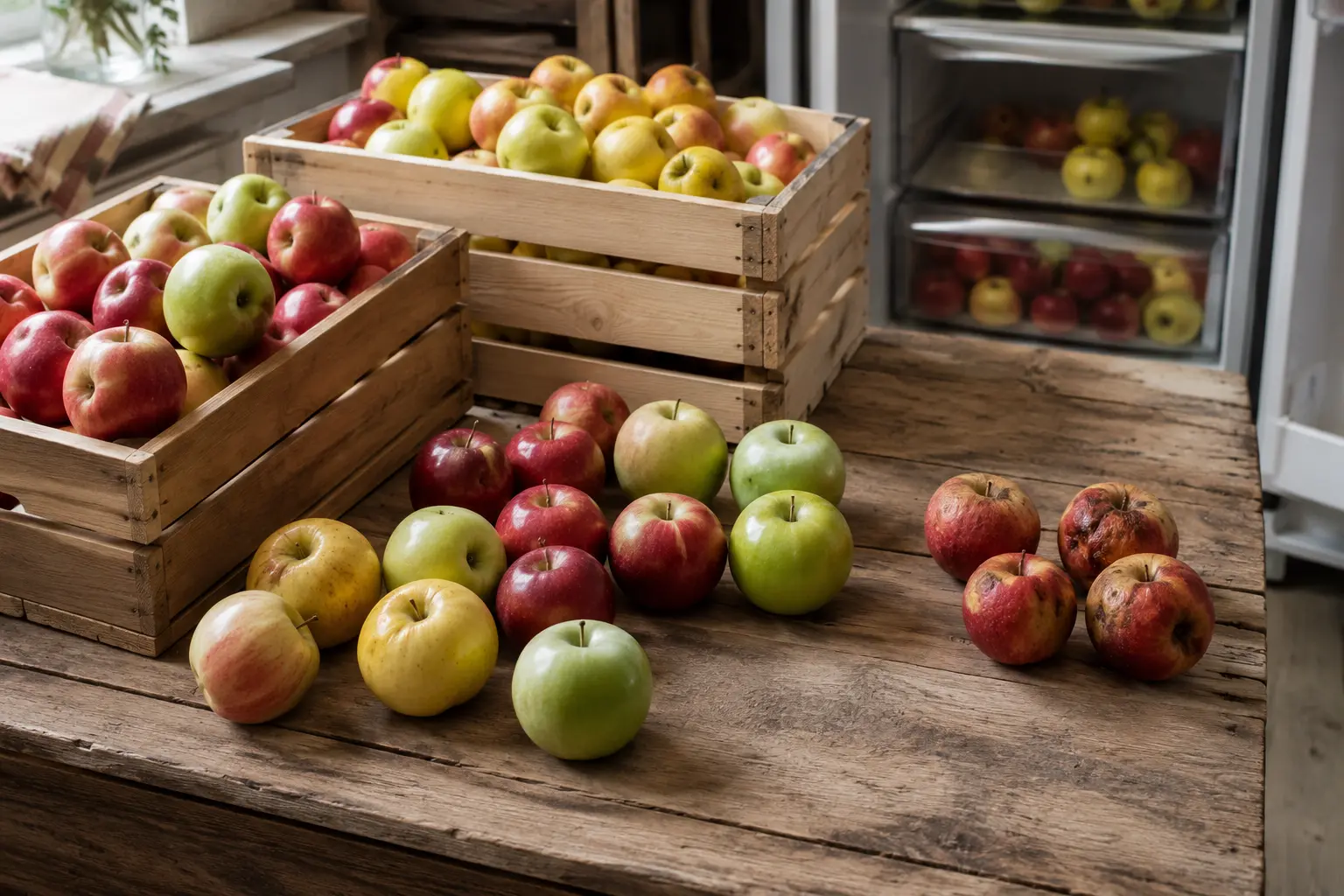
You do not need a root cellar to store apples. For a small harvest, sort out every bruised or damaged apple, leave the sound fruit unwashed, place it in perforated produce bags, and refrigerate it in a high-humidity crisper drawer. For larger quantities, use a second refrigerator or a clean, monitored basement, garage, or unheated room that stays roughly 32–40°F without freezing. Keep apples away from potatoes and ethylene-sensitive produce, check them weekly, and remove any fruit that begins to soften or rot.
Print a clean copy or save it as a PDF for the kitchen.
Saveable field method
How to store apples without a root cellar
A six-step method for sorting, packing, chilling, and inspecting home-grown or bulk-bought apples.
What you need
- Firm, mature apples without bruises, cuts, insect holes, or decay
- Refrigerator crisper, second refrigerator, or monitored cool room
- Perforated produce bags or plastic-lined clean crates
- Refrigerator or room thermometer
- Clean shallow trays or crates
- Choose apples that can keep
Set aside firm, mature, unbroken apples for storage. Use bruised, stem-punctured, insect-damaged, overripe, or fallen fruit promptly instead of mixing it with the keepers.
- Keep the fruit dry
Do not wash apples before storage. Brush off loose dry debris and wash each apple under running water just before eating or cooking.
- Pack without pressure
Place small quantities in perforated produce bags. For crates, use shallow clean containers and avoid deep piles that can bruise the lower fruit.
- Chill promptly
Move the sorted fruit into a refrigerator crisper or another monitored 32–40°F location. For longest quality, aim near 32°F while staying safely above the fruit's freezing point.
- Separate apples from other crops
Keep apples away from potatoes, winter squash, and other ethylene-sensitive produce. Use a separate crisper or storage zone when possible.
- Inspect every week
Check bags and crates for condensation, soft spots, mold, leakage, or off odors. Remove affected fruit immediately and use the ripest sound apples first.
Use the refrigerator crisper for a small apple harvest
A refrigerator crisper is the most dependable root-cellar substitute for a few pounds of apples. Iowa State University Extension recommends moving undamaged apples into storage immediately and gives an ideal target near 32°F with 90–95% relative humidity. Michigan State University Extension advises keeping apples in a perforated plastic bag in the refrigerator.
Set an adjustable crisper to high humidity, but do not seal wet fruit in an airtight bag. Perforations slow moisture loss while allowing some gas exchange and reducing trapped condensation. Keep the drawer clean and separate from raw meat, poultry, or fish. If your refrigerator runs closer to 40°F, the apples will still keep far longer than on a warm counter, but not as long as they would near 32°F.
Sort apples before they enter cold storage
Storage cannot improve damaged fruit. Keep only firm, mature apples without bruises, cuts, broken skin, insect holes, soft spots, or visible decay. A slightly damaged apple can be trimmed and cooked promptly if it is otherwise sound, but it should not share a bag or crate with the long-storage fruit.
Do not wash apples before storing them. Added moisture encourages surface deterioration, and handling can create tiny injuries. Brush off loose dry debris and wash under cool running water immediately before eating or preparing the fruit. Never use soap, bleach, or household cleaners on produce.
Use a second refrigerator for a bushel or more
A spare refrigerator is the simplest option for a larger quantity because it controls temperature better than most garages. Place apples in perforated bags or shallow clean crates, leave room for air circulation, and add a refrigerator thermometer instead of trusting the dial. Do not pack apples so deeply that the weight bruises the lower layers.
Keep varieties separate when practical and label the harvest date. Early-season apples usually soften sooner than late-season storage cultivars, so use the shortest-keeping group first. Iowa State notes that cultivars differ greatly: under optimum conditions, some may last only weeks while good keepers can retain quality for several months.
A garage or basement works only when you measure it
Iowa State lists cellars, unheated outbuildings, and garages as possible large-quantity storage locations, but only while conditions remain cold without freezing. Apples can freeze when the temperature drops below about 30°F and deteriorate rapidly after thawing. A garage that is safe in October may become unsafe during a sudden winter cold snap.
Use a min-max thermometer and choose an interior area away from sunlight, heaters, vehicle exhaust, paint, fuel, and strong odors. A clean insulated cabinet can soften temperature swings, but it is not a substitute for monitoring. Move the fruit to refrigeration before the space approaches freezing or repeatedly rises above 40°F.
- Best home target: near 32°F and 90–95% relative humidity.
- Practical refrigerator range: 32–40°F.
- Freeze risk: below about 30°F.
- Use perforated bags or shallow clean crates and inspect weekly.
Keep apples away from potatoes and winter squash
Apples release ethylene as they continue to ripen. Iowa State Extension advises not storing potatoes with apples because ethylene promotes tuber sprouting. The same source warns that apples and other ripening fruit shorten the storage life of winter squash.
Use separate crisper drawers, refrigerators, or storage zones whenever possible. Separation also makes inspection easier and prevents one crop's odor, moisture needs, or spoilage from affecting another. Apples need cold, humid storage; winter squash needs warmer, drier conditions, so one shared room is rarely ideal for both.
Is apple storage an Amish practice?
Cold-storing apples is a widespread orchard and household method, not a uniquely Amish practice. The Young Center for Amish Studies cautions that Amish affiliations and local church districts differ substantially, so a single storage routine should not be described as universal Amish tradition without direct documentation.
Plain & Frugal presents this as an Amish-inspired, old-fashioned goal—keep a seasonal harvest useful and waste less—using modern Extension guidance for temperature, humidity, packaging, and crop separation.
Frequently asked questions
How long do apples last in the refrigerator?
The variety and condition at harvest matter. Many apples can keep for one to three months in cold, humid home storage, while some good-keeping cultivars may last three to five months near 32°F and 90–95% humidity. Inspect the fruit rather than relying on one universal date.
Should you wash apples before storing them?
No. Store sound apples dry and unwashed. Wash them under cool running water just before eating or cooking, and never apply soap, bleach, or household cleaners.
Can apples be stored in a cardboard box?
A clean, shallow box can hold apples briefly in a reliably cold location, but perforated produce bags or plastic-lined crates retain humidity better. Avoid deep stacking, damp cardboard, and any box that previously held chemicals or spoiled produce.
Can you store apples in an unheated garage?
Only while a thermometer shows that the space remains roughly 32–40°F. Move apples before the garage falls below about 30°F or repeatedly warms above 40°F. Temperature swings make an unmonitored garage unreliable for long-term storage.
Can you store apples and potatoes together?
No. Ripening apples release ethylene gas, which Iowa State Extension says promotes potato sprouting. Store them in separate drawers, refrigerators, or rooms.
Do apples need to be wrapped individually?
Not when they are stored in perforated bags in a refrigerator crisper. Individual clean-paper wrapping can help isolate fruit in a crate, but correct temperature, humidity, gentle packing, and frequent inspection matter more.
Sources and further reading
- Iowa State University Extension — How to Harvest and Store Apples
- Iowa State University Extension — Harvesting and Storing Tree Fruit
- Michigan State University Extension — Using, Storing, and Preserving Apples
- University of Maine Cooperative Extension — Cold Storage Conditions
- University of Maine Cooperative Extension — Storing and Washing Fresh Fruits and Vegetables (May 29, 2025)
- Elizabethtown College Young Center — Amish Diversity
This article may use AI-assisted research organization and drafting. Claims involving safety, energy, or household costs are checked against the named sources above. Read about the founder and our editorial standards.