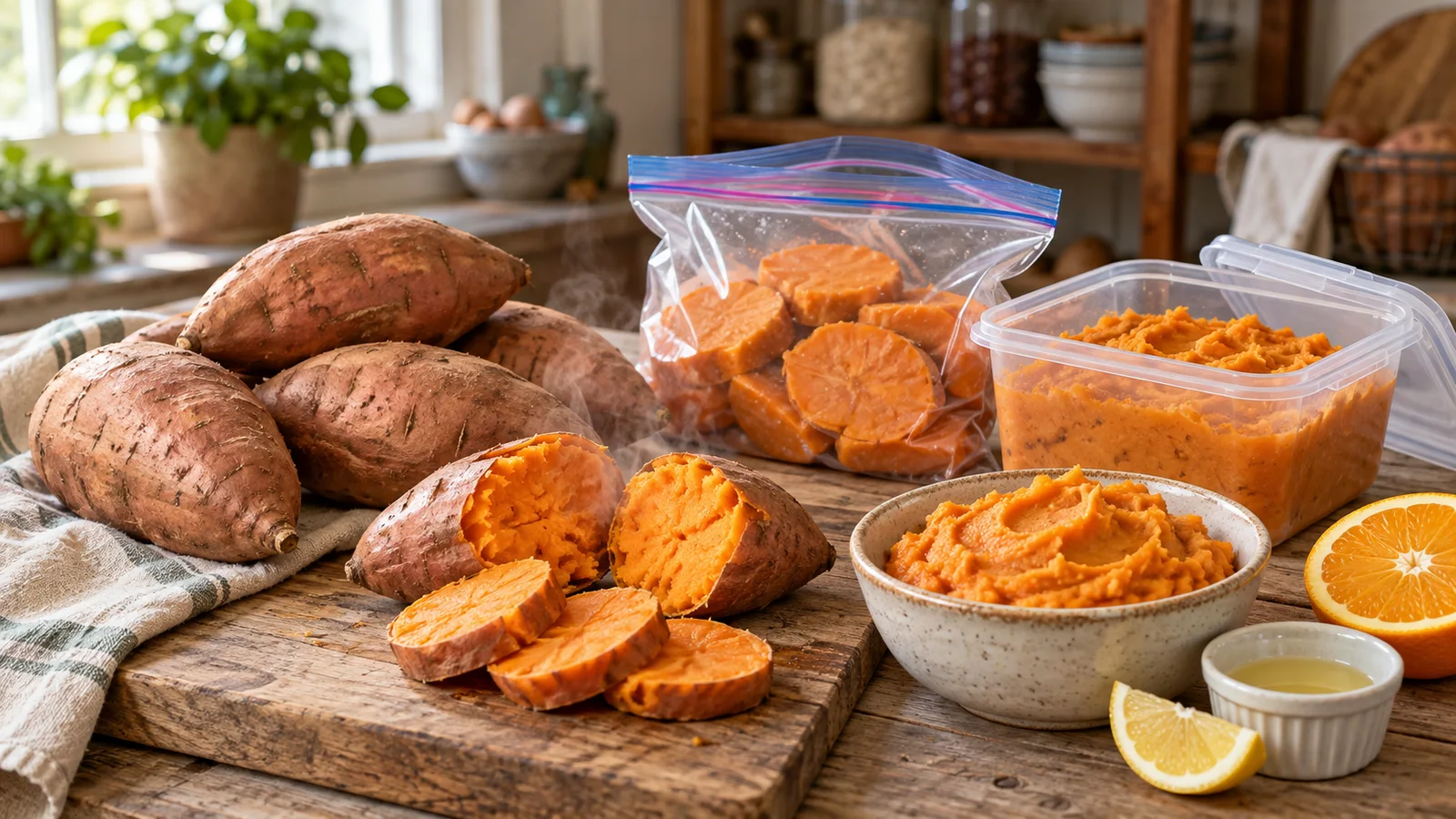
For reliable freezer quality, do not freeze raw sweet potatoes as your standard storage method. The National Center for Home Food Preservation says to use roots cured for at least one week, cook them until almost tender, cool, peel, and then halve, slice, or mash them. Pack with ½ inch of headspace. Whole or sliced potatoes may receive a 5-second lemon-water dip to limit darkening; mash uses 2 tablespoons orange or lemon juice per quart.
Print a clean copy or save it as a PDF for the kitchen.
Saveable field method
How to freeze sweet potatoes after partial cooking
Prepare cured sweet potatoes for the freezer as halves, slices, or mash using university Extension guidance.
What you need
- Medium to large sweet potatoes cured for at least one week
- Cold running water
- Optional lemon or orange juice
- Moisture-vapor-resistant freezer containers
- Labels and a permanent marker
- Pot, steamer, pressure cooker, or oven
- Knife and cutting board
- Potato masher for the purée option
- Measuring cup and spoons
- Start with cured roots
Choose sound medium to large sweet potatoes that have cured for at least one week. Sort by size and wash under running water.
- Cook until almost tender
Cook the whole roots in water, steam, a pressure cooker, or the oven until almost tender rather than completely soft.
- Cool and peel
Let the cooked sweet potatoes stand at room temperature until cool enough to handle, then remove the skins.
- Choose halves, slices, or mash
Cut the cooled potatoes into halves or slices, or mash them. Portion them for the recipes you expect to make.
- Limit darkening if desired
Dip whole potatoes or slices for 5 seconds in ½ cup lemon juice mixed with 1 quart water. For mash, mix in 2 tablespoons orange or lemon juice per quart.
- Pack, label, and freeze
Place the prepared sweet potatoes in freezer containers, leave ½ inch of headspace, seal, label with the form and date, and freeze promptly at 0°F or below.
Why raw sweet potatoes are not the standard freezer method
The research-based home-preservation method begins with cooking, not raw cubes. Freezing damages plant cells, so a raw sweet potato can develop disappointing texture, color, and cooking behavior after thawing. Cooking until almost tender gives a more predictable result for later meals.
You may see a separate internet technique that freezes a whole raw sweet potato before a long bake to change its texture. That is a cooking experiment, not the National Center for Home Food Preservation's storage method. This guide follows the preservation method for keeping a harvest or grocery surplus.
Cure homegrown sweet potatoes for at least one week first
The NCHFP and Illinois Extension both specify medium to large sweet potatoes that have been cured for at least one week. Curing helps freshly harvested roots heal small wounds and improves storage quality. Store-bought sweet potatoes have usually already passed through postharvest handling, but reject roots with soft spots, mold, deep cuts, or decay.
Wash the roots just before preparation and sort them by size so they cook evenly. If you harvested them yourself, follow the site's complete sweet-potato curing guide before moving part of the crop to the freezer.
Cook until almost tender, then cool and peel
Cook the sweet potatoes in boiling water, steam, a pressure cooker, or the oven. Stop when they are almost tender: a knife should enter with some resistance, because the potatoes will be cooked again in the final dish. The official method does not give a single number of minutes because root size and cooking method vary.
Let the cooked roots stand at room temperature until cool enough to handle, then peel them. Do not leave cooked food sitting out for an extended period; portion and freeze promptly once preparation is complete.
Freeze halves, slices, or mashed sweet potatoes
Halves and slices work well for casseroles, soups, skillets, and side dishes. Mash is convenient for pies, breads, muffins, pancakes, and sweet-potato casserole. Portion the food according to a real recipe so you do not need to thaw more than you can use.
For optional color protection, dip whole cooked potatoes or slices for 5 seconds in a mixture of ½ cup lemon juice and 1 quart water. For mashed sweet potatoes, mix 2 tablespoons orange or lemon juice into each quart of mash. These measured treatments are for darkening control, not canning acidification.
Use the separate method for individually baked sweet potatoes
For an individually wrapped baked option, wash and trim the potatoes without peeling. Heat them at 350°F until slightly soft, cool, remove the skins, and wrap each potato in aluminum foil. Place the wrapped potatoes in freezer bags.
When serving, finish baking them immediately in a 350°F oven while they remain wrapped in foil. This method is different from fully baking a potato, leaving it at room temperature, and freezing it later without a plan.
Leave ½ inch of headspace and use within a year
Pack halves, slices, or mash into freezer containers with ½ inch of headspace, then seal, label, and freeze at 0°F or below. Headspace allows expansion in a rigid container. In a freezer bag, remove excess air while keeping enough room for the food to expand.
Michigan State University Extension recommends using frozen sweet potatoes within one year for quality. Keep the package continuously frozen, rotate older portions forward, and discard food that showed spoilage before freezing or develops an unexpected off odor or appearance after thawing.
Thaw for mash; cook pieces from frozen when practical
Thaw mashed sweet potato in the refrigerator before mixing it into pies or batters. Halves and slices can often go directly into soups, casseroles, or a covered reheating dish; add cooking time and verify the center is hot before serving.
Frozen sweet potatoes will not have the crisp bite of a fresh raw root. Plan to use them in cooked dishes where their softer texture is useful rather than expecting them to behave like freshly cut raw fries.
Is freezing sweet potatoes an Amish practice?
No. Freezing sweet potatoes is a general modern food-preservation method, not a practice unique to Amish households. Amish affiliations and local church districts differ in their use of electricity and household technology, so freezer use should never be generalized to all Amish people.
Reducing waste and preparing a harvest for winter fit a broadly frugal, old-fashioned mindset. The exact cooking, citrus, packaging, and temperature directions here come from university-based preservation guidance rather than an unsupported cultural claim.
Frequently asked questions
Can you freeze raw sweet potato cubes?
For dependable storage quality, use the NCHFP method: cook cured sweet potatoes until almost tender, cool, peel, and then cut or mash them before freezing. Raw cubes are not the published preservation method.
Do sweet potatoes need to be blanched before freezing?
They need more than the short blanch used for many vegetables. Cook whole sweet potatoes until almost tender in water, steam, a pressure cooker, or the oven before cooling, peeling, and freezing.
How do you keep frozen sweet potatoes from turning dark?
Optionally dip whole cooked potatoes or slices for 5 seconds in ½ cup lemon juice mixed with 1 quart water. For mash, mix in 2 tablespoons orange or lemon juice per quart.
How much headspace do frozen sweet potatoes need?
Leave ½ inch of headspace in rigid freezer containers. Seal, label, and freeze promptly at 0°F or below.
How long do frozen sweet potatoes keep?
Michigan State University Extension recommends using them within one year for best quality. Keep them continuously frozen at 0°F or below.
Can you freeze mashed sweet potatoes?
Yes. Cook, cool, peel, and mash the sweet potatoes, optionally mix in 2 tablespoons orange or lemon juice per quart to reduce darkening, then pack with ½ inch of headspace and freeze.
Sources and further reading
- National Center for Home Food Preservation — Freezing Sweet Potatoes
- Illinois Extension — Preparing Sweet Potatoes
- Michigan State University Extension — Using, Storing, and Preserving Sweet Potatoes
- NC Cooperative Extension — Harvest of the Month: Sweet Potatoes (updated May 8, 2024)
- Young Center for Anabaptist and Pietist Studies — Amish Diversity
This article may use AI-assisted research organization and drafting. Claims involving safety, energy, or household costs are checked against the named sources above. Read about the founder and our editorial standards.