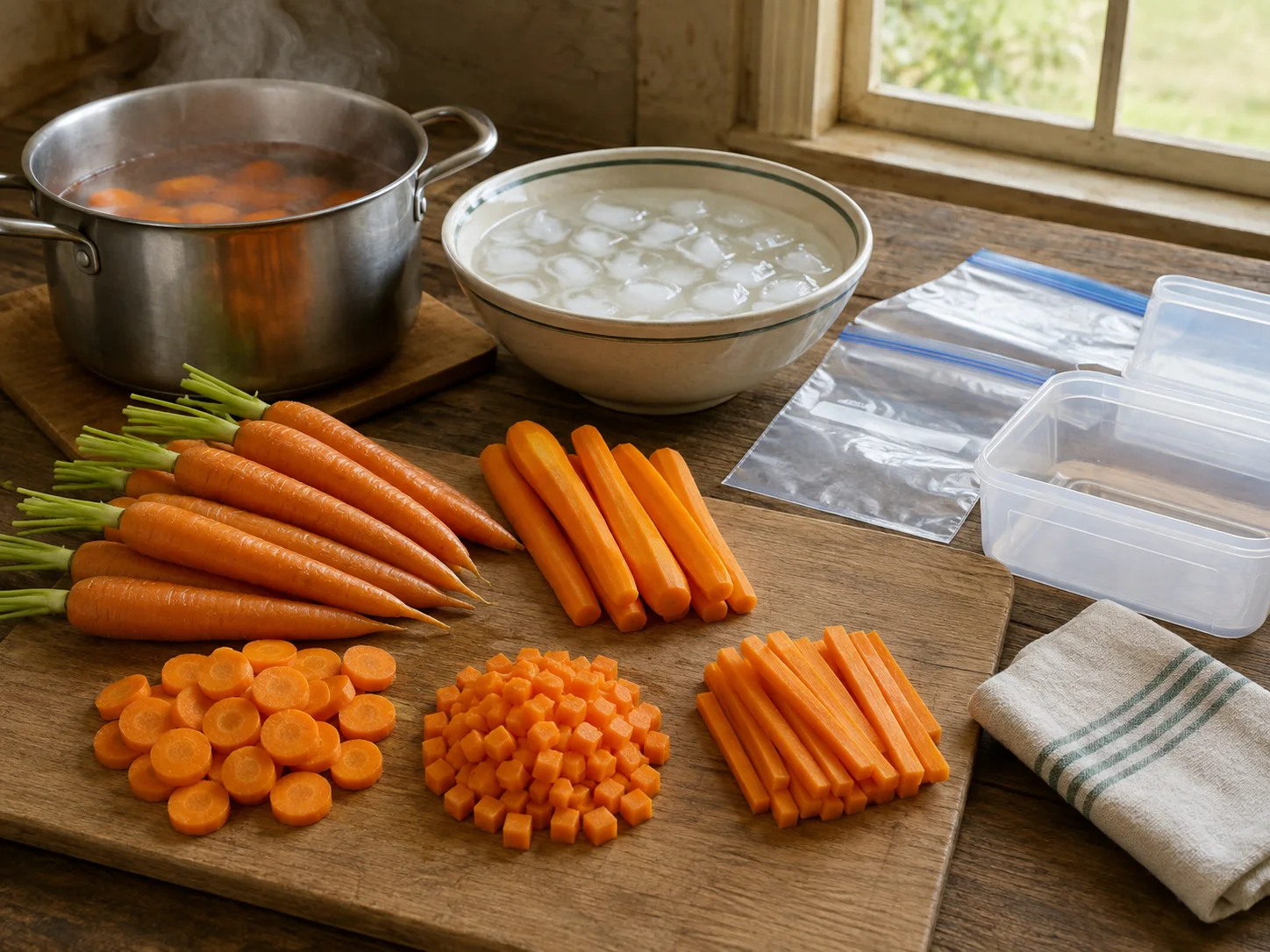
You can physically freeze carrots without blanching, but it is not the tested best-quality method for longer storage. The National Center for Home Food Preservation recommends removing the tops, washing and peeling young tender carrots, then water-blanching small whole carrots for 5 minutes or thin slices, ¼-inch cubes, and lengthwise strips for 2 minutes. Cool promptly, drain, package with ½ inch of headspace, seal, and freeze at 0°F (-18°C) or below.
Print a clean copy or save it as a PDF for the kitchen.
What happens when carrots are frozen raw?
Raw carrot pieces will become frozen, but freezing alone does not stop every enzyme that gradually damages a vegetable's flavor, color, texture, and nutrients. The shortcut may look successful at first while producing a less dependable result after longer storage.
Blanching is a short timed heat treatment, not full cooking. University of Minnesota Extension lists peppers, onions, leeks, and green onions as exceptions to the usual blanch-first rule; carrots are not on that exception list. The official carrot directions therefore use blanching before cooling and freezing.
The tested way to freeze carrots
Choose young, tender, coreless, medium-length carrots. Remove the tops, rinse the uncut carrots under cool running water, scrub them with a clean produce brush, and peel. Do not use soap, bleach, sanitizer, or commercial produce wash.
Prepare the ice-water bath before the carrots enter the pot. Separate small whole carrots from cut pieces because they require different blanching times, and work in modest batches so the water returns to a boil within 1 minute.
- Leave genuinely small carrots whole, or cut larger carrots into thin slices, ¼-inch cubes, or lengthwise strips.
- Use about 1 gallon of vigorously boiling water for each pound of prepared carrots.
- Lower one batch into the water, cover, and begin timing when the water returns to a boil.
- Water-blanch small whole carrots for 5 minutes.
- Water-blanch thin slices, ¼-inch cubes, or lengthwise strips for 2 minutes.
- Move the carrots promptly into plenty of ice water, cool thoroughly, and drain well.
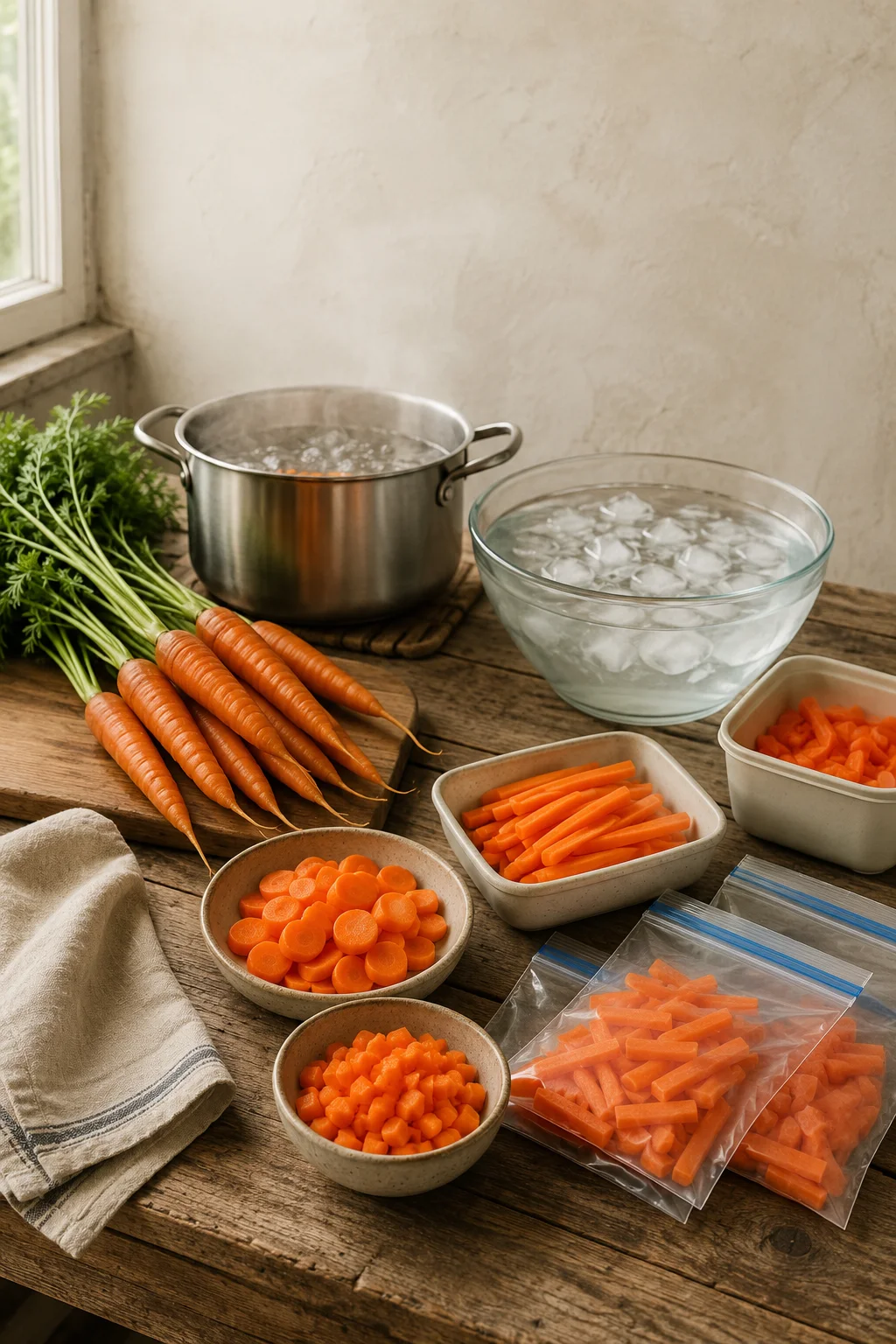
- Pack in freezer bags or rigid freezer containers, leaving ½ inch of headspace; remove excess air, seal, label, and freeze promptly.
Should you tray-freeze carrot pieces?
Tray-freezing is optional but useful when you want loose pieces instead of one solid block. After blanching, cooling, and draining, spread the carrots in a single layer on a shallow tray and freeze only until firm, then transfer them promptly to airtight freezer packaging.
The tray step does not replace blanching. Its purpose is portion control: you can pour a handful into soup, stew, casserole, pot pie, or a skillet without thawing the entire package.
Can you freeze shredded carrots?
The National Center's carrot directions specify small whole carrots, thin slices, ¼-inch cubes, and lengthwise strips; they do not provide a separate blanching time for shredded carrots. Applying the 2-minute time to fine shreds would be an unsupported guess because smaller pieces heat differently.
For a research-based batch, choose one of the listed cuts. If you need grated carrot for baking, freeze a tested finished recipe or consult your local Cooperative Extension office for current guidance rather than inventing a blanching time.
How long frozen carrots keep
Properly prepared and packaged fruits and vegetables have an approximate best-quality range of 8 to 12 months at 0°F (-18°C) or below, according to the National Center. That range assumes correct blanching, suitable freezer packaging, and a steady temperature.
Label each package with the cut, date, and intended dish, and use the oldest package first. Food kept continuously frozen remains safe longer, but quality declines; freezing does not sterilize food or improve the quality of old, woody carrots.
Is freezing carrots an Amish practice?
No. Freezing carrots is a general modern home-preservation method, not a uniquely Amish practice. The Young Center for Amish Studies cautions against generalizing about all Amish groups because technology choices vary among affiliations, communities, and local church districts.
The useful Amish-inspired principle is simply to preserve a seasonal surplus for meals the household will actually cook. The carrot sizes, blanching times, packaging, and storage guidance here come from current research-based sources—not cultural folklore.
Frequently asked questions
How long do you blanch carrots before freezing?
Water-blanch thin slices, ¼-inch cubes, and lengthwise strips for 2 minutes. Small whole carrots need 5 minutes. Start timing when the water returns to a boil, then cool promptly in ice water and drain.
Do carrots need to be peeled before freezing?
The National Center's tested preparation says to remove the tops, wash, and peel the carrots before leaving small ones whole or cutting larger carrots into the listed shapes.
Can you freeze baby carrots without blanching?
Do not assume every packaged 'baby carrot' matches the tested small-whole-carrot category. For dependable quality, wash and peel as directed and water-blanch genuinely small whole carrots for 5 minutes before cooling and packaging.
Can you freeze raw shredded carrots?
Raw shreds will freeze, but the National Center does not publish a separate blanching time for shredded carrots. Use one of its tested shapes—thin slices, ¼-inch cubes, lengthwise strips, or small whole carrots—rather than guessing a time for fine shreds.
Do frozen carrots need to be thawed before cooking?
For soups, stews, casseroles, and skillets, properly prepared frozen carrot pieces can usually go directly into the cooking process. Use a small portion and avoid prolonged cooking if you want them to retain more shape.
Sources and further reading
- National Center for Home Food Preservation — Freezing Carrots
- National Center for Home Food Preservation — Blanching Vegetables
- University of Minnesota Extension — Blanching Vegetables
- National Center for Home Food Preservation — Frozen Food Storage Times
- FoodSafety.gov — Safe Ways to Handle and Clean Produce
- Elizabethtown College Young Center — Amish Diversity
This article may use AI-assisted research organization and drafting. Claims involving safety, energy, or household costs are checked against the named sources above. Read about the founder and our editorial standards.