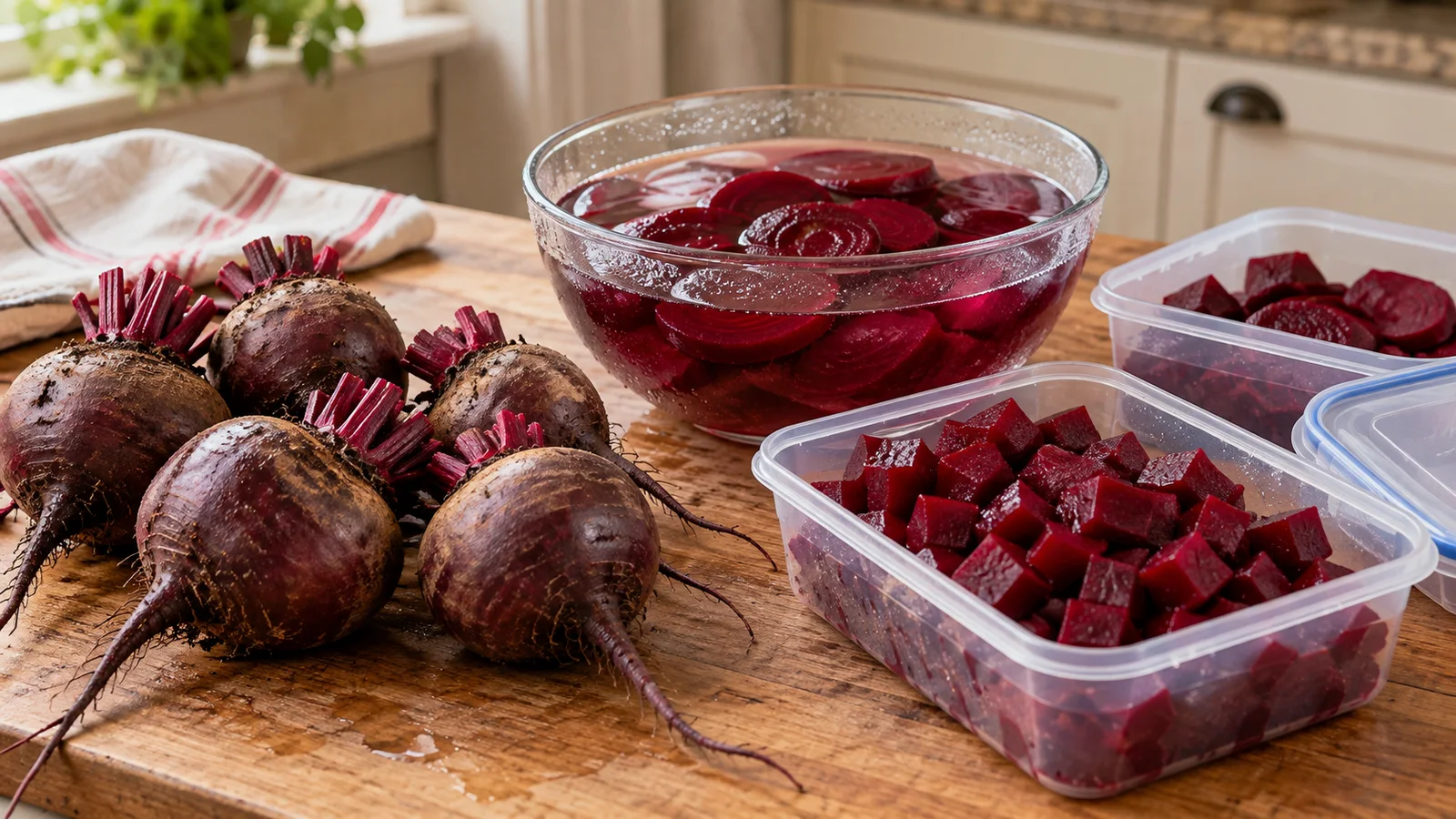
For dependable freezer quality, do not freeze raw beet cubes as your standard method. The National Center for Home Food Preservation says to cook whole beets in boiling water until tender—25 to 30 minutes for small beets or 45 to 50 minutes for medium beets—then cool promptly, peel, slice or cube, and pack with ½ inch of headspace. Leave ½ inch of stem and the taproot attached during cooking to limit color loss.
Print a clean copy or save it as a PDF for the kitchen.
Saveable field method
How to freeze cooked beets
Cook, cool, peel, portion, and package garden or market beets using the National Center for Home Food Preservation method.
What you need
- Deep-red, tender young beets
- Cold running water
- Ice for a cold-water bath
- Moisture-vapor-resistant freezer containers
- Labels and a permanent marker
- Large pot with a lid
- Colander or slotted spoon
- Knife and cutting board
- Timer
- Select and sort
Choose firm, tender young beets without decay. Wash well and sort them into small and medium groups so each batch cooks evenly.
- Trim without cutting the root
Remove the greens, leaving ½ inch of stem. Keep the taproot attached during cooking to reduce bleeding and color loss.
- Cook until tender
Boil small beets for 25 to 30 minutes and medium beets for 45 to 50 minutes, until tender. Process the size groups separately.
- Cool promptly
Transfer the cooked beets immediately to cold water. Cool them thoroughly so they stop cooking and become easier to handle.
- Peel and cut
Slip off the skins, remove the remaining stem and taproot, and cut the beets into uniform slices or cubes.
- Pack, label, and freeze
Place the cooled pieces in freezer containers, leave ½ inch of headspace, seal, label with the date and form, and freeze promptly at 0°F or below.
Why raw beet cubes are not the research-based freezer method
The published home-freezing method starts by cooking whole beets until tender. It does not give a short blanching time for raw cubes. Freezing raw vegetables leaves enzymes active enough to keep changing flavor, color, texture, and nutrients, so skipping the recommended heat treatment can produce a disappointing package even though it freezes solid.
This is mainly a quality issue, not a claim that a frozen raw beet cube instantly becomes unsafe. For a repeatable result that holds its color and works well in later meals, follow the tested preparation: cook whole, cool, peel, cut, and package.
Choose tender beets and sort them by size
Select firm, deep-red, tender young beets without soft spots, mold, or decay. Illinois Extension notes that roots larger than about 3 inches can become tough and fibrous. Freezing preserves the quality you start with; it cannot repair a woody or deteriorating root.
Wash thoroughly, then sort the beets into small and medium groups. Size matters because the official cooking times differ substantially. Mixing a tiny beet with a much larger one can leave one overcooked while the other remains firm in the center.
Leave ½ inch of stem and the taproot attached
Trim away the greens but leave about ½ inch of stem and keep the taproot intact during cooking. The NCHFP explains that this helps prevent the beets from bleeding color into the water. Do not peel or cut the roots before this cooking step.
Beet greens are edible, but they are a separate food with a different freezer preparation. Wash and preserve sound greens using a tested leafy-greens method rather than packing raw tops together with the roots.
Boil small beets 25–30 minutes and medium beets 45–50 minutes
Bring enough water to a boil to cover the sorted roots. Cook small beets for 25 to 30 minutes and medium beets for 45 to 50 minutes, until tender. Start and finish each size group separately so every beet receives the appropriate treatment.
These are full cooking times, not the brief blanch used for carrots, broccoli, or many other vegetables. The goal is a tender cooked beet. If your harvest includes unusually large roots, use the tender stage rather than inventing a raw-cube blanching time that the published method does not provide.
Cool promptly, then peel, slice, or cube
Move the cooked beets directly into cold water. Prompt cooling stops the cooking process and makes the roots easier to handle. Once cool, slip off the skins, cut away the remaining stem and taproot, and slice or cube the flesh.
Choose a size that matches the meals you actually cook. Slices are convenient for warm salads and side dishes; cubes work well in borscht, grain bowls, roasted vegetable mixtures, and purées. Keep the pieces reasonably uniform so portions thaw and reheat consistently.
Leave ½ inch of headspace and freeze at 0°F
Pack the cooled slices or cubes in moisture-vapor-resistant freezer containers, leaving ½ inch of headspace. Seal, label with the product, cut, portion, and date, then freeze promptly at 0°F or below. Headspace gives the food room to expand without pushing open a rigid container.
The NCHFP lists 8 to 12 months as the approximate best-quality range for properly prepared and packaged fruits and vegetables at 0°F. Longer-frozen food may remain safe if continuously frozen, but its color, flavor, and texture can decline. Rotate packages first in, first out.
Use thawed beets where a softer texture works
Frozen beets are already cooked, so they are most useful in dishes that need reheating rather than crisp raw texture. Add frozen cubes directly to soups or borscht, or thaw a portion in the refrigerator for salads, hummus, purée, or a warm side dish.
Expect some softening after freezing and thawing. Drain excess liquid when a recipe needs a drier result, and season after reheating so you can judge the final flavor accurately.
Is freezing beets an Amish practice?
No. Freezing beets is a general modern food-preservation method, not a practice unique to Amish households. Amish affiliations and church districts differ in technology use, so freezer habits should not be generalized across Amish communities.
Using a garden harvest fully and reducing waste fit a broadly frugal, old-fashioned mindset. The exact trimming, cooking, cooling, packaging, and temperature directions in this guide come from university-based preservation guidance rather than an unsupported cultural claim.
Frequently asked questions
Can you freeze raw beet cubes?
Raw cubes are not the NCHFP's published method. For dependable quality, cook whole beets until tender, cool promptly, peel, then slice or cube them before freezing.
Do beets need to be blanched before freezing?
They need more than a brief blanch. Boil small whole beets for 25–30 minutes or medium beets for 45–50 minutes, until tender, before cooling and peeling.
Why leave the stem and taproot on while cooking beets?
Leaving ½ inch of stem and the taproot attached helps reduce bleeding and color loss during cooking. Remove both after the beets have cooled.
Can you roast beets before freezing them?
Cooked roasted beets can be frozen, but the research-based method with exact times cited here uses boiling water. Use that method when you want the most repeatable instructions.
How much headspace do frozen beets need?
Leave ½ inch of headspace in rigid freezer containers. Seal, label, and freeze promptly at 0°F or below.
How long do frozen beets keep?
For best quality, use properly prepared and packaged frozen vegetables within about 8 to 12 months at 0°F or below.
Sources and further reading
- National Center for Home Food Preservation — Freezing Beets
- National Center for Home Food Preservation — Frozen Food Storage Times
- National Center for Home Food Preservation — Packaging and Labeling Foods
- Illinois Extension — Growing, Harvesting, and Storing Beets
- Young Center for Anabaptist and Pietist Studies — Amish Diversity
This article may use AI-assisted research organization and drafting. Claims involving safety, energy, or household costs are checked against the named sources above. Read about the founder and our editorial standards.