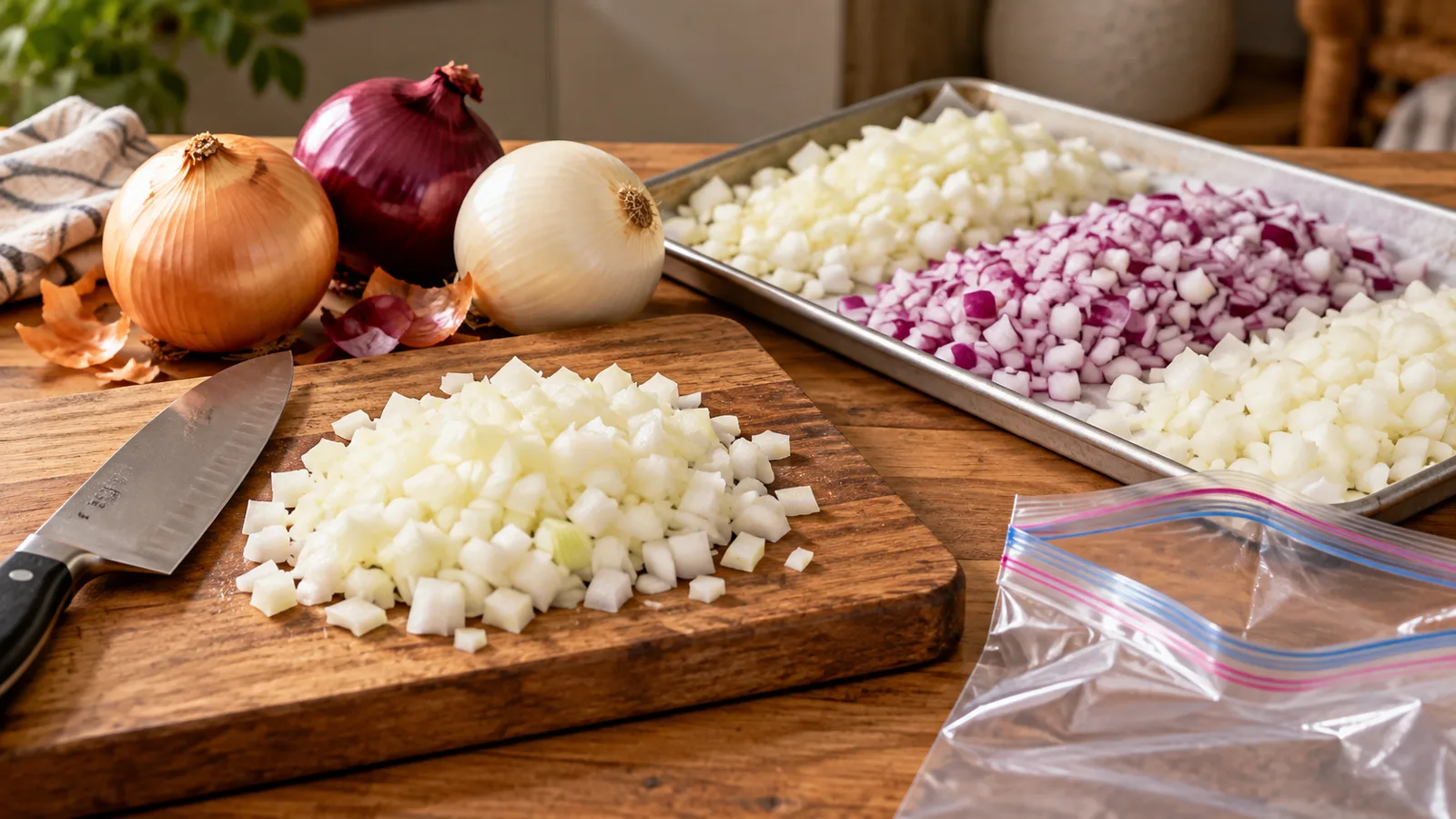
Yes. Diced bulb onions can be frozen without blanching. The National Center for Home Food Preservation says to peel, trim, clean, and dice them into pieces about ¼ inch across, then either dry-pack them with ½ inch of headspace or tray-freeze the pieces before packaging with as much air removed as possible. Use frozen onions in cooked dishes and, for best quality, use diced onions prepared this way within a few months.
Print a clean copy or save it as a PDF for the kitchen.
Saveable field method
How to freeze diced onions without blanching
Prepare, dice, package, and freeze bulb onions using the National Center for Home Food Preservation method.
What you need
- Sound yellow, white, or red bulb onions
- Cold running water
- Moisture-vapor-resistant freezer bags or containers
- Labels and a permanent marker
- Sharp chef's knife
- Cutting board
- Measuring ruler or visual ¼-inch guide
- Clean tray for optional loose freezing
- Choose sound onions
Use firm bulb onions without mold, soft spots, or decay. Freezing will not improve an onion that has already begun to spoil.
- Peel, trim, and clean
Remove the papery skin and root and stem ends. Clean the onions thoroughly and keep the cutting board and knife clean.
- Dice to about ¼ inch
Cut the onions into reasonably even pieces about ¼ inch across. No blanching is required for this diced-onion method.
- Choose dry pack or tray pack
For a dry pack, put the diced onion directly into freezer bags or containers. For loose pieces, spread them on a clean tray in one layer and freeze before transferring them to packaging.
- Seal with the correct space
Leave ½ inch of headspace for a dry pack. For tray-frozen pieces, remove as much air as possible from the package before sealing to limit odor transfer and freezer burn.
- Label, freeze, and use cooked
Label with the cut and date, freeze promptly at 0°F or below, and use within a few months for best quality in soups, stews, casseroles, sauces, and skillet dishes.
Which onions can be frozen raw?
Yellow, white, and red bulb onions can all be diced and frozen without blanching. Begin with firm onions free from mold, wet spots, or decay, because freezing preserves the condition you start with rather than restoring freshness.
Young green onions may also be chopped and frozen without blanching. The NCHFP notes that they will not remain crisp and may become slightly tough, so reserve them for cooking rather than salad garnish.
Dice onions to about ¼ inch
Peel, trim, and clean the onions thoroughly, then dice them into pieces about ¼ inch across. Reasonably even pieces are easier to measure from frozen and cook more consistently than a mixture of tiny mince and large chunks.
No boiling-water, steam, or microwave blanching step is needed for the NCHFP diced-onion method. This is a specific exception; it does not mean every vegetable can skip its published blanching time.
Dry pack or tray-freeze for loose pieces
The simplest option is a dry pack: portion the freshly diced onion directly into moisture-vapor-resistant freezer bags or containers and leave ½ inch of headspace.
For onion pieces that pour out separately, spread the dice in one layer on a clean tray and freeze until firm before transferring them to a freezer bag. Press out as much air as possible. This extra step makes it easier to remove only the amount a recipe needs.
Control onion odor in the freezer
Onion aroma can migrate through weak packaging. Use bags or containers made for freezing, close them tightly, and consider a second freezer bag if the first seal is thin or likely to open during storage.
Label the package clearly with the food, cut, and date. Flattening a bag into a thin layer speeds freezing and lets you break off portions without repeatedly opening a large rigid container.
Whole onions need a different method
Freezing is usually not the best way to preserve whole bulb onions because cured bulbs already keep well in a cool, dry, ventilated place. If you do freeze them whole, the NCHFP method says to blanch small onions for about 3 minutes and larger onions for up to 7 minutes, or until the center is completely heated.
Cool whole blanched onions promptly, drain well, package with ½ inch of headspace, and use them only in cooked dishes. Do not apply the no-blanch diced-onion directions to a whole bulb.
Onion rings are a third method
The NCHFP's breaded onion-ring method water-blanches separated rings for only 10 to 15 seconds, then cools and drains them before coating with flour, milk, and equal parts cornmeal and pancake mix.
The coated rings are frozen in one layer and packaged with plastic wrap between layers; no headspace is needed. That method is designed for rings fried directly from frozen and should not be confused with plain diced onions.
How long do frozen diced onions keep?
The NCHFP specifically says onions frozen by the diced method are best used within a few months. That shorter, onion-specific recommendation is more useful here than applying the general 8-to-12-month range for fruits and vegetables.
Keep the freezer at 0°F or below, rotate older packages forward, and use them first. Discard onion that showed spoilage before freezing or develops an unexpected sign of spoilage after thawing.
Is freezing onions an Amish practice?
No. Freezing diced onions is a general modern kitchen method, not a practice unique to Amish households. Amish communities differ in technology use, so freezer practices should never be attributed to all Amish people.
Using a surplus before it spoils is broadly frugal. The preparation and packaging directions here come from university-based home food-preservation guidance, not from an unsupported cultural claim.
Frequently asked questions
Do onions need to be blanched before freezing?
Not when they are diced into pieces about ¼ inch across. The NCHFP diced-onion method requires no blanching. Whole bulb onions and prepared onion rings use different blanching directions.
Can you freeze whole onions without blanching?
The NCHFP does not recommend that method. Whole onions should be water-blanched for 3 to 7 minutes, depending on size, or until the center is completely heated, then cooled and packed with ½ inch of headspace.
Can you freeze red onions raw?
Yes. Peel, clean, and dice them to about ¼ inch, then dry-pack or tray-freeze them. Expect a softer texture after thawing and use them in cooked dishes.
Can you freeze green onions without blanching?
Yes. Young green onions may be chopped and frozen without blanching, but they will not remain crisp and may become slightly tough. Use them for cooking rather than fresh garnish.
How much headspace do diced onions need?
Leave ½ inch of headspace when dry-packing diced onions. If you tray-freeze the pieces first, remove as much air as possible from the final package.
Do you thaw frozen onions before cooking?
Usually not. Add diced onion directly from the freezer to soups, stews, casseroles, sauces, and skillets. Thawed onion is soft and is not a good replacement for crisp raw onion in salads or sandwiches.
Sources and further reading
- National Center for Home Food Preservation — Freezing Onions
- National Center for Home Food Preservation — How Long Can I Store Frozen Foods?
- National Center for Home Food Preservation — Packaging and Labeling Foods
- Young Center for Anabaptist and Pietist Studies — Amish Diversity
This article may use AI-assisted research organization and drafting. Claims involving safety, energy, or household costs are checked against the named sources above. Read about the founder and our editorial standards.