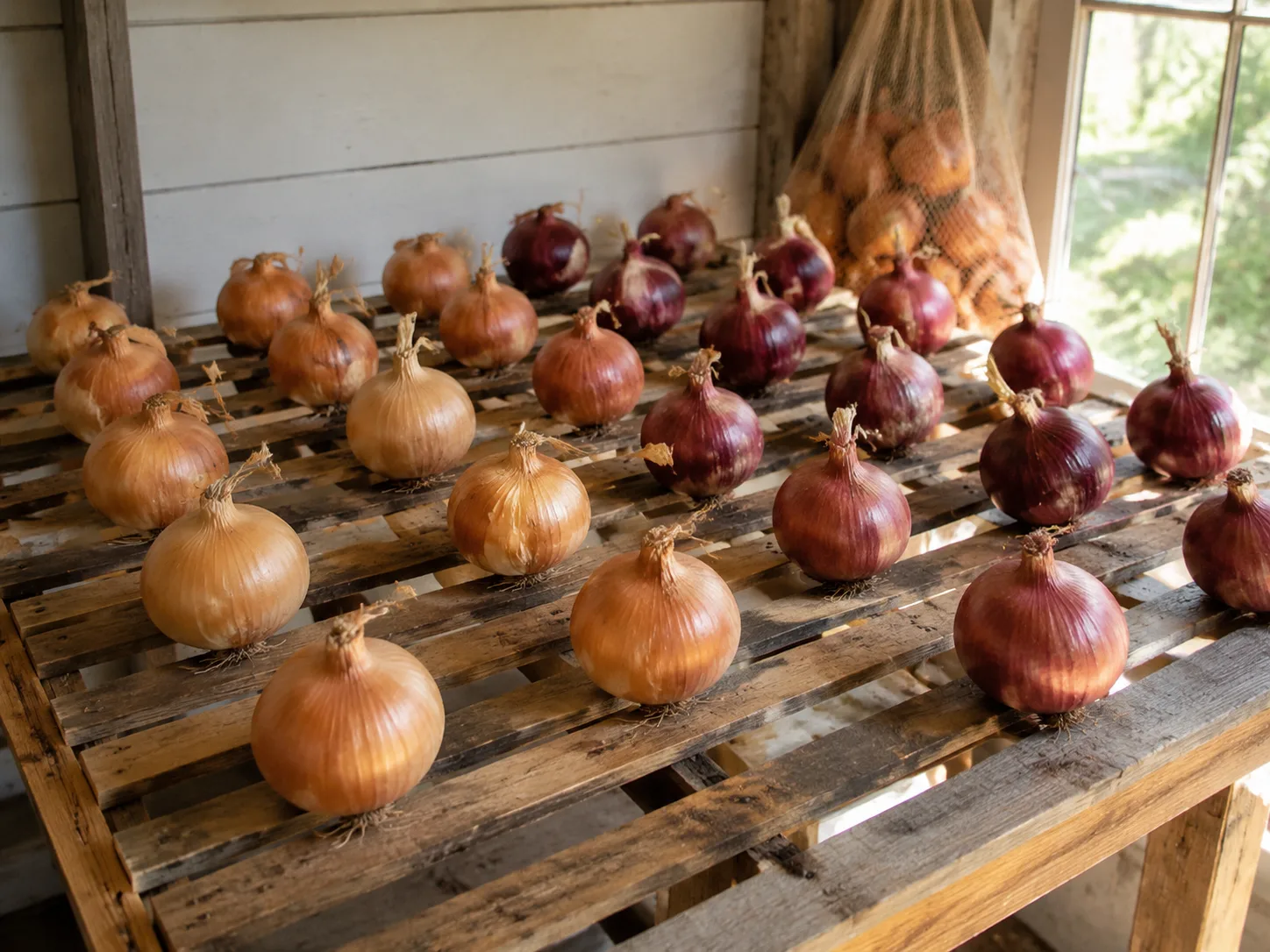
Harvest bulb onions when most tops have fallen over and begun to dry. Keep the tops attached, do not wash the bulbs, and spread them in one layer in a warm, dry, well-ventilated place for 2 to 3 weeks. They are ready when the necks and roots are dry and the outer skins rustle. Trim the tops about 1 inch above the bulbs, remove damaged or thick-necked onions, and store the sound bulbs in a mesh bag, wire basket, or open crate at 32–40°F with moderate dryness and good airflow.
Print a clean copy or save it as a PDF for the kitchen.
Saveable field method
How to cure onions for storage
A six-step home-garden method for taking mature bulb onions from harvest to ventilated cold storage.
What you need
- Mature storage onions with tops attached
- Clean slatted rack, screen, or dry surface
- Mesh bag, wire basket, or ventilated crate
- Thermometer for the storage area
- Wait for maturity
Harvest when most tops have fallen over and begun to dry. Choose a dry day and handle each bulb gently.
- Lift with the tops attached
Carefully pull or dig the onions. Do not wash them or cut off the leaves before curing.
- Spread in one airy layer
Move the onions to a warm, dry, well-ventilated shed, garage, or covered area. Keep rain and condensation away.
- Cure for 2 to 3 weeks
Turn or check the onions as needed. Wait until the necks and roots are dry and the outer skins feel papery and rustle.
- Trim and sort
Cut dry tops about 1 inch above the bulbs. Set aside thick-necked, bruised, sprouting, soft, or damaged onions for prompt use.
- Store with airflow
Place sound onions in a mesh bag, wire basket, or open crate at 32–40°F and about 65–70% relative humidity. Check them regularly.
Know when storage onions are ready to harvest
Iowa State University Extension says onions are ready when most tops have fallen over and begun to dry. Carefully pull or dig the bulbs with the tops still attached. Harvesting in dry weather and avoiding cuts or bruises gives each onion a better chance of surviving storage.
This method is for mature bulb onions intended for storage. Green onions, immature bulbs, and very sweet onions have different keeping qualities. Variety matters: Iowa State notes that storage life depends on the cultivar as well as harvest, curing, and storage conditions. Plan to use damaged or thick-necked bulbs first rather than expecting every onion to last all winter.
Cure onions in one dry, ventilated layer
Leave the foliage attached and spread the onions in a single layer on a clean, dry surface, screen, or slatted rack. A shed or garage works when it stays dry and air can move around the bulbs. Do not pile fresh onions into a deep crate, close them in plastic, or expose them to rain during curing.
Iowa State recommends curing for 2 to 3 weeks. Utah State gives the same 2-to-3-week range in a well-ventilated area out of direct sunlight. Do not judge by the calendar alone: the tops and necks should be thoroughly dry, the roots dry, and the outer scales papery enough to rustle when handled.
- Keep the bulbs dry; do not wash storage onions before curing.
- Use one layer so air reaches the neck and outer skins.
- Protect the crop from rain, dew, and condensation.
- Wait for dry necks and papery skins before trimming.
Trim, sort, and keep weak bulbs out of storage
Once the onions are completely cured, Iowa State advises cutting the tops about 1 inch above the bulbs. You may instead leave fully dry foliage attached and braid it. Brush away loose dry soil gently, but keep the bulbs dry until you wash them just before kitchen use.
Sort as carefully as you trim. Discard decayed bulbs and use thick-necked onions promptly because they do not store well. Also separate bulbs that are bruised, cut, soft, sprouting, or showing mold. Utah State identifies moist neck tissue as a major entry point for Botrytis neck rot, which may not become visible until 4 to 8 weeks into storage.
Use a breathable container and measure the room
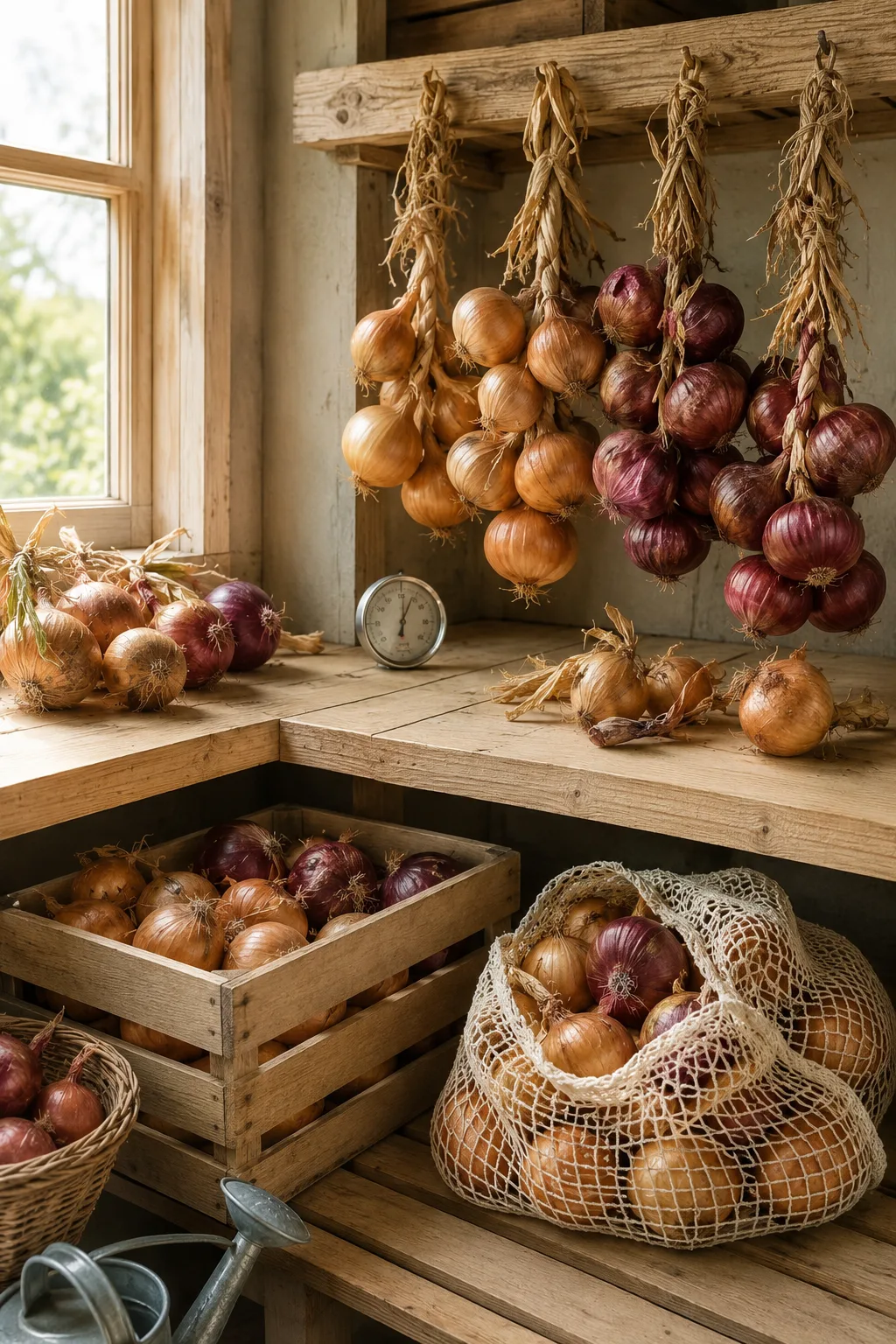
A mesh bag, old nylon stocking, wire basket, or open crate can work because each allows air to circulate. A sealed plastic tote traps moisture and is a poor substitute. Do not overfill the container, and place it where you can inspect the bulbs without unpacking an entire winter supply.
Iowa State recommends 32–40°F and 65–70% relative humidity for long-term onion storage. A basement, cellar, or garage may work if it stays in range, but an unheated garage must not freeze. Use a simple thermometer instead of assuming a room is cool enough. Under good conditions, Iowa State lists an average storage life of 5 to 8 months, though sweet onions and weaker keepers may last much less time.
Check onions regularly instead of storing and forgetting
Look through the container every week or two. Remove any onion that is softening, leaking, moldy, strongly odorous, or sprouting so one failure does not sit against sound bulbs. If the room becomes warm or damp, shorten your storage expectations and move a manageable amount to a better location.
Whole dry onions need airflow; cut onions need refrigeration in a covered container. Wash a bulb under running water when you are ready to prepare it, not before long-term dry storage. The goal is not to preserve every bulb indefinitely—it is to notice changes early and use the harvest in the best order.
Is curing onions an Amish practice?
Curing and ventilated storage are widespread horticultural methods, not uniquely Amish practices. A farm, homestead, or recipe described as Amish does not prove that every Amish family follows the same harvest routine. The Young Center for Amish Studies emphasizes substantial differences among affiliations and local church districts.
Plain & Frugal uses the old-fashioned principle—dry the crop well, store it simply, and inspect it regularly—while grounding the temperatures, humidity, and timing in current university Extension guidance. That distinction is more useful than attaching an unsupported cultural label to a general garden technique.
Frequently asked questions
How long should onions cure after harvest?
Allow about 2 to 3 weeks in a warm, dry, well-ventilated place. Store them only after the necks and roots are dry and the outer skins are papery and rustle.
Should you wash onions before curing them?
No. University Extension guidance for long-term storage onions says not to wash them before curing. Keep the bulbs dry, remove loose soil gently, and wash each onion under running water just before use.
Can onions cure in a garage?
Yes, if the garage is dry, well ventilated, protected from rain and condensation, and not so hot that the bulbs cook. Spread them in one layer rather than piling them in a closed container.
How do you know when onions are fully cured?
The tops, necks, and roots should be completely dry, and the outer bulb scales should feel papery and rustle. A thick or still-green neck is not ready for long-term storage.
What temperature is best for storing cured onions?
Iowa State recommends 32–40°F with 65–70% relative humidity and good airflow. Keep the bulbs above freezing and inspect them regularly.
How long do homegrown onions last in storage?
Iowa State lists an average of 5 to 8 months under good conditions. Actual life depends on variety, maturity, curing quality, damage, temperature, humidity, and how quickly failing bulbs are removed.
Sources and further reading
- Iowa State University Extension — Harvest, Dry, and Store Onions
- Iowa State University Extension — Storing Winter Storage Vegetables
- Utah State University Extension — Harvest and Storage of Vegetables and Fruits
- Utah State University Extension — Botrytis Neck Rot of Onion
- University of Illinois Extension — Extend Garden Vegetable Shelf Life
- Elizabethtown College Young Center — Amish Diversity
This article may use AI-assisted research organization and drafting. Claims involving safety, energy, or household costs are checked against the named sources above. Read about the founder and our editorial standards.