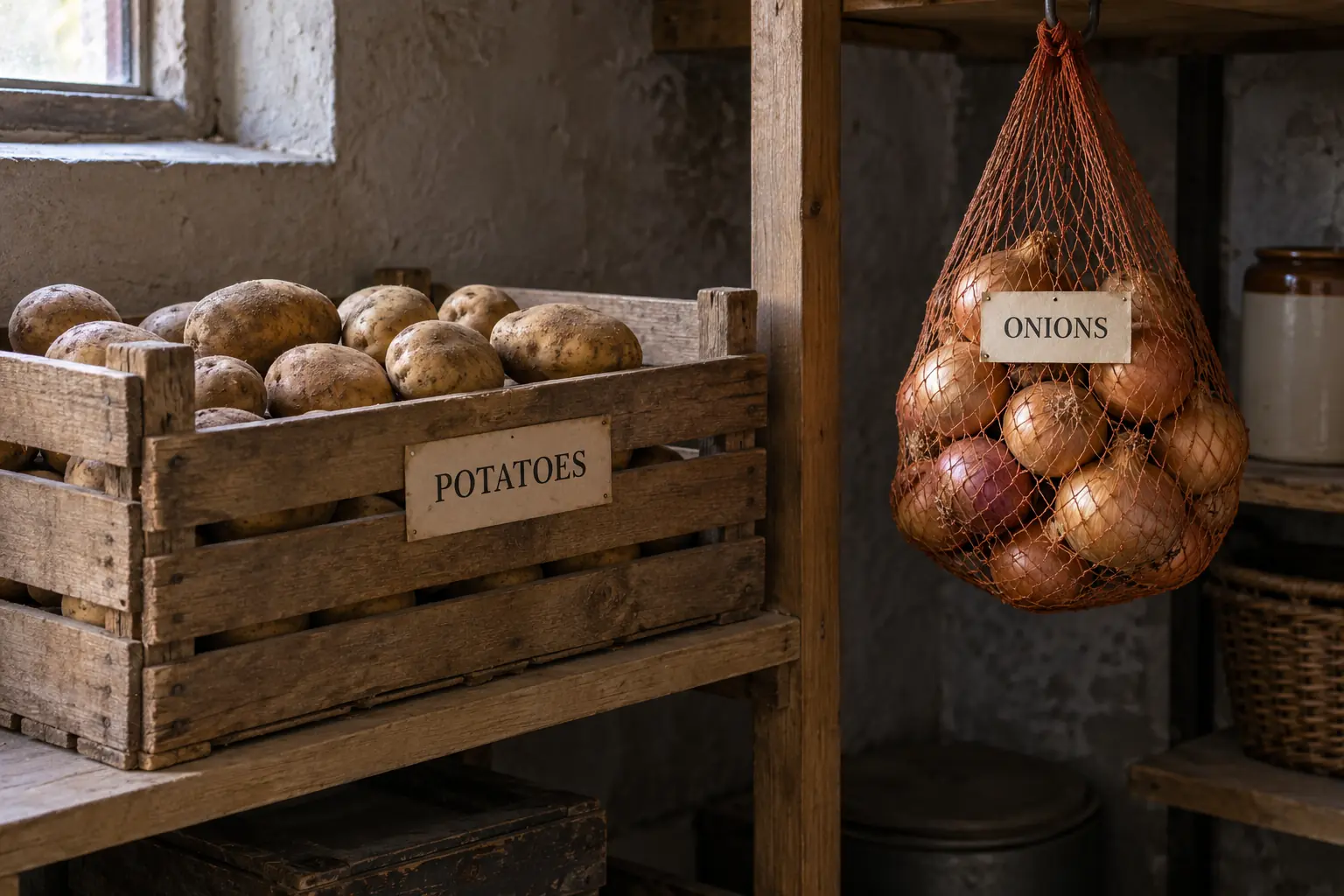
No—not for storage beyond a few days. Onions need a cool, moderately dry, ventilated place; potatoes need darkness and generally higher humidity. Iowa State University Extension warns that onions can make potatoes spoil prematurely, while moisture from potatoes can make onions brown and rot. Keep them in two breathable containers, preferably on different shelves or in separate storage zones, and inspect both every week.
Print a clean copy or save it as a PDF for the kitchen.
Saveable field method
How to store onions and potatoes separately
Cure, sort, and place onions and potatoes in separate ventilated containers suited to each crop's humidity and light needs.
What you need
- Sound, fully cured potatoes
- Sound, fully cured onions
- Paper bags, crates, mesh bags, or wire baskets that allow airflow
- Two separate shelves or storage zones
- Room thermometer
- Optional hygrometer
- Cure each crop separately
Cure homegrown potatoes for about two weeks at 50–60°F and 85–90% relative humidity. Cure onions for two to three weeks in a warm, dry, well-ventilated place until their necks and outer skins are thoroughly dry.
- Sort before storage
Set aside cut, bruised, soft, damp, or decaying produce for prompt use or disposal. Use thick-necked onions first because they do not store well.
- Keep the produce unwashed
Brush away loose dry soil, but do not wash potatoes or onions before storage. Added surface moisture encourages decay; wash only when you are ready to cook.
- Give potatoes darkness and humidity
Place potatoes in an opaque but ventilated crate, slotted box, or paper bag. Aim for about 40°F and 90–95% relative humidity when you can control conditions, and block all light that could cause greening.
- Keep onions drier
Put onions in a mesh bag, wire basket, old nylon stocking, or ventilated crate. Iowa State recommends 32–40°F and 65–70% relative humidity. Do not close them in plastic.
- Separate and inspect weekly
Use different shelves or storage zones rather than one shared bin. Remove any sprouting, soft, wet, moldy, or foul-smelling item before it affects the rest of the crop.
The best conditions for stored potatoes
For homegrown potatoes, cure sound tubers first. Iowa State recommends two weeks at 50–60°F and 85–90% relative humidity so minor cuts can heal and skins can thicken. Then move them into a dark, ventilated container; light causes greening.
Extension recommendations vary slightly because cooking use and household storage spaces differ. Iowa State gives an ideal long-storage target of 40°F and 90–95% relative humidity. Iowa State AnswerLine uses a practical home range of 45–50°F and warns that refrigerator temperatures can make potatoes sweeter and cause dark cooking. The constants are more useful than a single perfect number: keep potatoes cool, dark, ventilated, unwashed, and away from onions and ripening fruit.
The best conditions for stored onions
Onions must be thoroughly cured before they go into storage. Iowa State recommends two to three weeks in a warm, dry, well-ventilated place, followed by 32–40°F and 65–70% relative humidity. Use a mesh bag, wire basket, crate, or braided dry tops so air can circulate.
Discard decaying bulbs and use thick-necked onions promptly. Never let an unheated garage fall below freezing around the crop, and do not seal onions in a plastic tote or bag. A dry, breathable onion zone is the opposite of the humid environment potatoes tolerate best.
A practical setup for a small kitchen or apartment
You do not need two rooms. Use two containers in the coolest dark cupboard, closet, basement corner, or insulated garage zone that remains above freezing. Put potatoes in the darker, slightly more humid location and onions in the drier, breezier location. Different shelves are better than side-by-side bins, and one shared closed cabinet is less useful if it traps moisture.
Buy smaller quantities if your home stays warm. At room temperature, potatoes may last only about two weeks, according to Iowa State AnswerLine. A modest amount that you check weekly wastes less money than a large bargain bag that sprouts or rots before you can use it.
Is separate onion-and-potato storage an Amish practice?
No. Separating onions and potatoes is general produce-storage guidance based on humidity, light, and plant physiology; it is not an exclusively Amish custom. The Young Center notes substantial variation among Amish affiliations and local church districts, including differences in accepted technologies.
This guide is Amish-inspired only in the broad plain-living goal of keeping a harvest useful with simple equipment. Its specific storage targets come from university Extension sources, not from a claim about universal Amish practice.
Frequently asked questions
How far apart should onions and potatoes be stored?
There is no tested minimum distance. The practical goal is to avoid a shared container and shared humid microclimate. Put them on different shelves or in separate storage zones with independent airflow.
Can onions and potatoes stay in the same pantry?
Yes, if the pantry is cool and dark and each crop has its own breathable container. Keep potatoes in the darker, more humid part and onions in the drier, better-ventilated part. Inspect both weekly.
Should potatoes be stored in the refrigerator?
For ordinary home use, Iowa State AnswerLine recommends a cool 45–50°F location rather than the refrigerator because colder temperatures can turn starch to sugar, affecting flavor and browning. Iowa State's controlled long-storage target is about 40°F. Use a cool, dark pantry or cellar when available.
What containers are best for onions and potatoes?
Use breathable containers: an opaque ventilated crate, slotted box, or paper bag for potatoes, and a mesh bag, wire basket, crate, or braided dry tops for onions. Avoid sealed plastic containers for either crop.
Should you wash onions or potatoes before storage?
No. Brush off loose dry soil and wash only when you are ready to use them. Surface moisture makes decay more likely during storage.
Can garlic be stored with onions?
Properly cured garlic and onions can share the same cool, dry, ventilated zone because Iowa State recommends 32–40°F and 65–70% relative humidity for both. Keep them in separate breathable containers so a problem in one batch is easier to spot and remove.
Sources and further reading
- Iowa State University Extension AnswerLine — Sprouting or Greening Potatoes (reviewed March 2024)
- Iowa State University Extension — Storing Winter Storage Vegetables
- University of Minnesota Extension — Harvesting and Storing Home Garden Vegetables
- University of Minnesota Extension — Growing Onions in Home Gardens
- Illinois Extension — Learn How to Preserve Your Produce Like a Pro (September 1, 2023)
- Young Center for Anabaptist and Pietist Studies — Amish Diversity
This article may use AI-assisted research organization and drafting. Claims involving safety, energy, or household costs are checked against the named sources above. Read about the founder and our editorial standards.