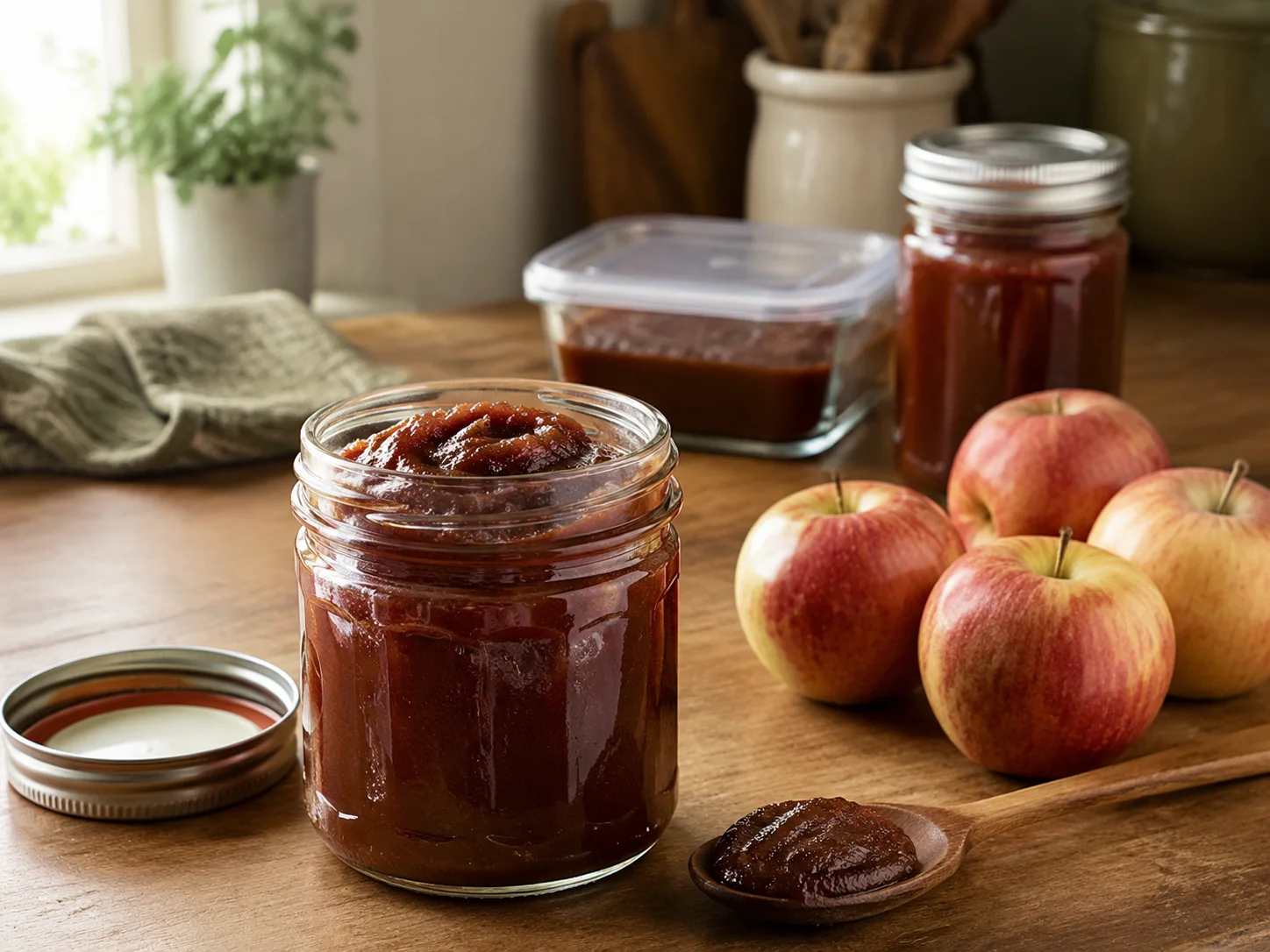
Yes. Homemade apple butter that has not completed a research-tested canning process must be refrigerated or frozen; pouring it hot into a jar and hearing the lid pop does not make it shelf-stable. University of Minnesota Extension gives cooked refrigerator fruit spreads a one-month refrigerator life or one year in the freezer. A sealed jar processed exactly with a tested apple-butter recipe may be stored unopened in a cool, dark place; once opened, refrigerate it.
Print a clean copy or save it as a PDF for the kitchen.
Choose one of three safe storage paths
Decide how you will store the batch before you cook it. Refrigerator and freezer batches allow more recipe flexibility because cold temperature controls storage. Pantry storage is different: it requires a research-tested formulation, the specified jar size and headspace, a real boiling-water or approved atmospheric steam process, and an altitude-adjusted processing time.
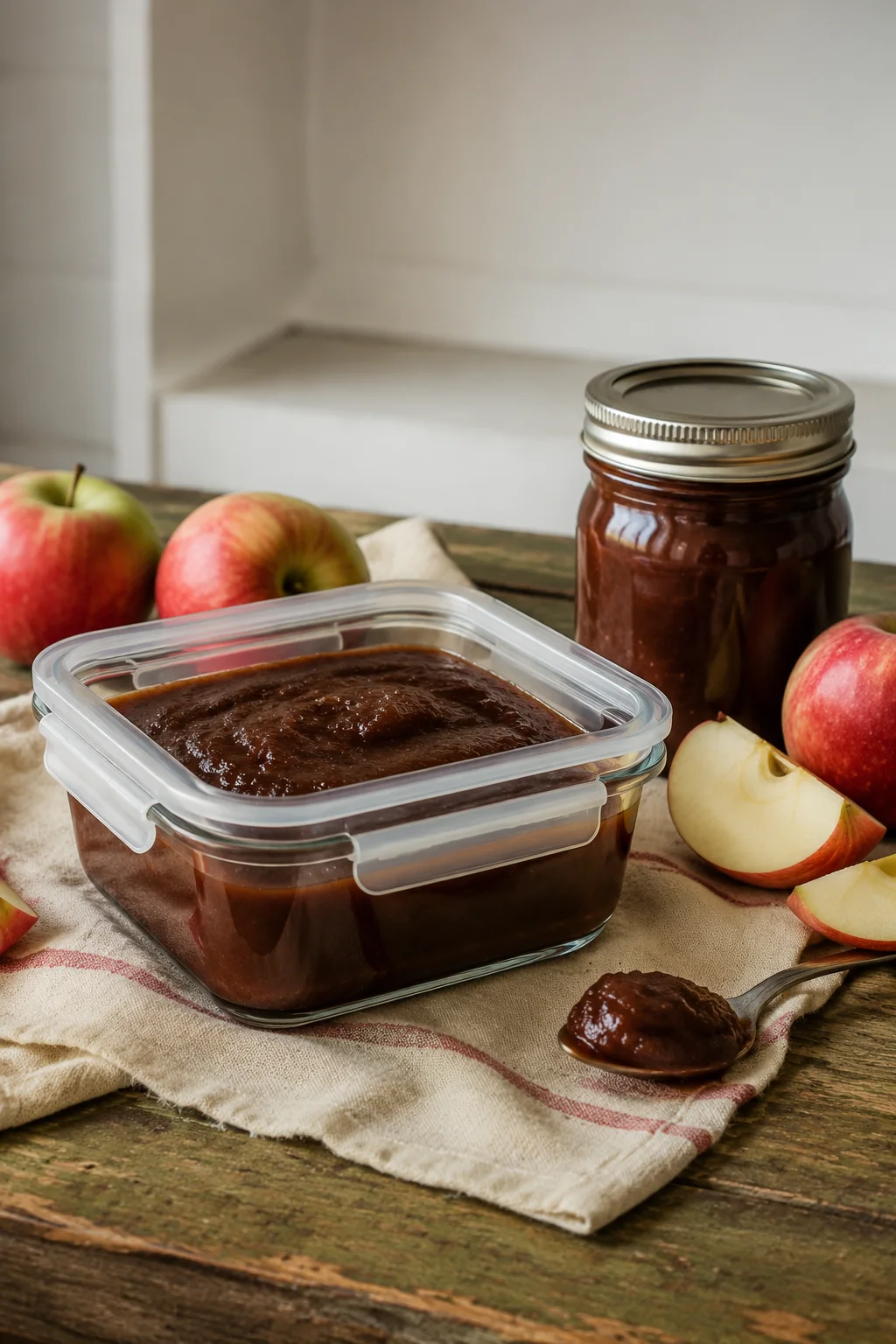
University of Minnesota Extension says cooked fruit spreads may be refrigerated for one month or frozen for one year. For freezing, leave about ½ inch of headspace so the spread can expand. If using glass, choose a straight-sided container labeled for freezing; ordinary jars may crack.
- Refrigerator: cover, label, chill promptly, and use within 1 month.
- Freezer: use freezer-safe packaging, leave about ½ inch of headspace, and use within 1 year for best quality.
- Pantry: use only a tested canning recipe and complete every processing step for your jar size and altitude.
- After opening any properly canned jar: refrigerate it until used.
Why a popped lid is not proof of safe canning
Hot apple butter can pull a lid downward as the jar cools, creating a vacuum. That seal shows only that a vacuum formed; it does not prove that the food received a tested heat process. Penn State Extension specifically warns that hot-fill-hold is not recommended for home canners, and that all canned apple products—including apple butter—must be processed.
Vacuum-sealing a mason jar is not a substitute either. University of Minnesota explains that cooked homemade sauces and spreads sealed with a vacuum device still require refrigerator or freezer storage unless a validated canning process is used. A sealed lid and a shelf-stable product are not the same claim.
What the tested NCHFP apple-butter process requires
The National Center for Home Food Preservation publishes a complete apple-butter formula using apples, apple cider, vinegar, white and brown sugar, cinnamon, and cloves. The cooked pulp is filled hot into jars with ¼ inch of headspace, then processed in a boiling-water canner. Follow that formula as written rather than borrowing only its processing time for a different slow-cooker recipe.
At elevations from 0 to 1,000 feet, NCHFP specifies 5 minutes for half-pints or pints and 10 minutes for quarts. From 1,001 to 6,000 feet, the times are 10 and 15 minutes; above 6,000 feet, they are 15 and 20 minutes. Half-pint and pint jars processed for only 5 minutes must be sterile before filling. The recipe page links to the complete jar, lid, canner, and cooling instructions.
Can you can your favorite slow-cooker recipe?
Not automatically. Thickness, acidity, sugar, added liquid, jar size, and ingredient substitutions can change heat penetration and preservation behavior. A recipe that tastes good and becomes very thick is not necessarily a tested canning formula.
If your family recipe does not match a current USDA, NCHFP, or university Extension recipe, treat it as refrigerator or freezer apple butter. Do not add butter, oil, thickeners, pumpkin, or other low-acid ingredients and then reuse an apple-butter processing time. Refrigeration is not a failure; it is the correct storage method for an untested variation.
How to store and check canned jars
University of Minnesota recommends storing correctly canned food in a clean, cool, dark, dry place and using home-canned food within 12 months for best quality. Label each jar with the product and processing date. Keep any unsealed jar refrigerated rather than placing it on the pantry shelf.
Before serving, discard a jar with a bulging lid, broken seal, leaking liquid, spurting contents, mold, off odor, or other evidence of spoilage. Never taste food to decide whether questionable home canning is safe. Once a sound jar is opened, cover and refrigerate the remaining apple butter.
Is apple butter specifically Amish?
No. Apple butter has a long history in multiple American communities, and recipes labeled “Amish apple butter” do not establish a universal Amish household practice. The Young Center for Amish Studies stresses that Amish affiliations and local church districts differ in technology and daily customs.
Plain & Frugal therefore treats apple butter as a broadly traditional food. The useful old-fashioned idea is to turn seasonal apples into a versatile spread; the storage rules here come from current home-preservation research, not from a cultural label or nostalgic hot-fill method.
Frequently asked questions
How long does homemade apple butter last in the refrigerator?
University of Minnesota Extension gives cooked refrigerator fruit spreads a one-month shelf life. Keep the apple butter covered, labeled, and continuously refrigerated; discard it sooner if mold, fermentation, an off odor, or another spoilage sign appears.
Does apple butter need refrigeration after opening?
Yes. Refrigerate an opened jar whether it was commercially produced or safely canned at home, and follow the manufacturer's instructions for a commercial product.
Is apple butter shelf-stable if the lid sealed by itself?
No. A vacuum seal created by hot filling does not prove that the jar received a validated canning process. Refrigerate or freeze the batch unless it was made and processed with a current tested recipe.
Can homemade apple butter be frozen?
Yes. Use freezer-safe containers, leave about ½ inch of headspace for expansion, label the package, and freeze. University of Minnesota lists one year for the best quality of frozen cooked fruit spreads.
Can you water-bath can apple butter?
Yes, when you use a tested apple-butter recipe. The NCHFP recipe uses a boiling-water canner, ¼-inch headspace, approved jar sizes, and processing times adjusted for elevation. Do not apply its time to an untested recipe.
Can mold be scraped off apple butter?
No. Discard the entire container if mold appears. Do not taste questionable apple butter or try to rescue the unaffected-looking portion.
Sources and further reading
- National Center for Home Food Preservation — Apple Butter
- University of Minnesota Extension — Fruit Spreads
- University of Minnesota Extension — Home Canning
- Penn State Extension — Preserving the Amazing Apple
- University of Minnesota Extension — Vacuum-Sealing Mason Jars
- Elizabethtown College Young Center — Amish Diversity
This article may use AI-assisted research organization and drafting. Claims involving safety, energy, or household costs are checked against the named sources above. Read about the founder and our editorial standards.