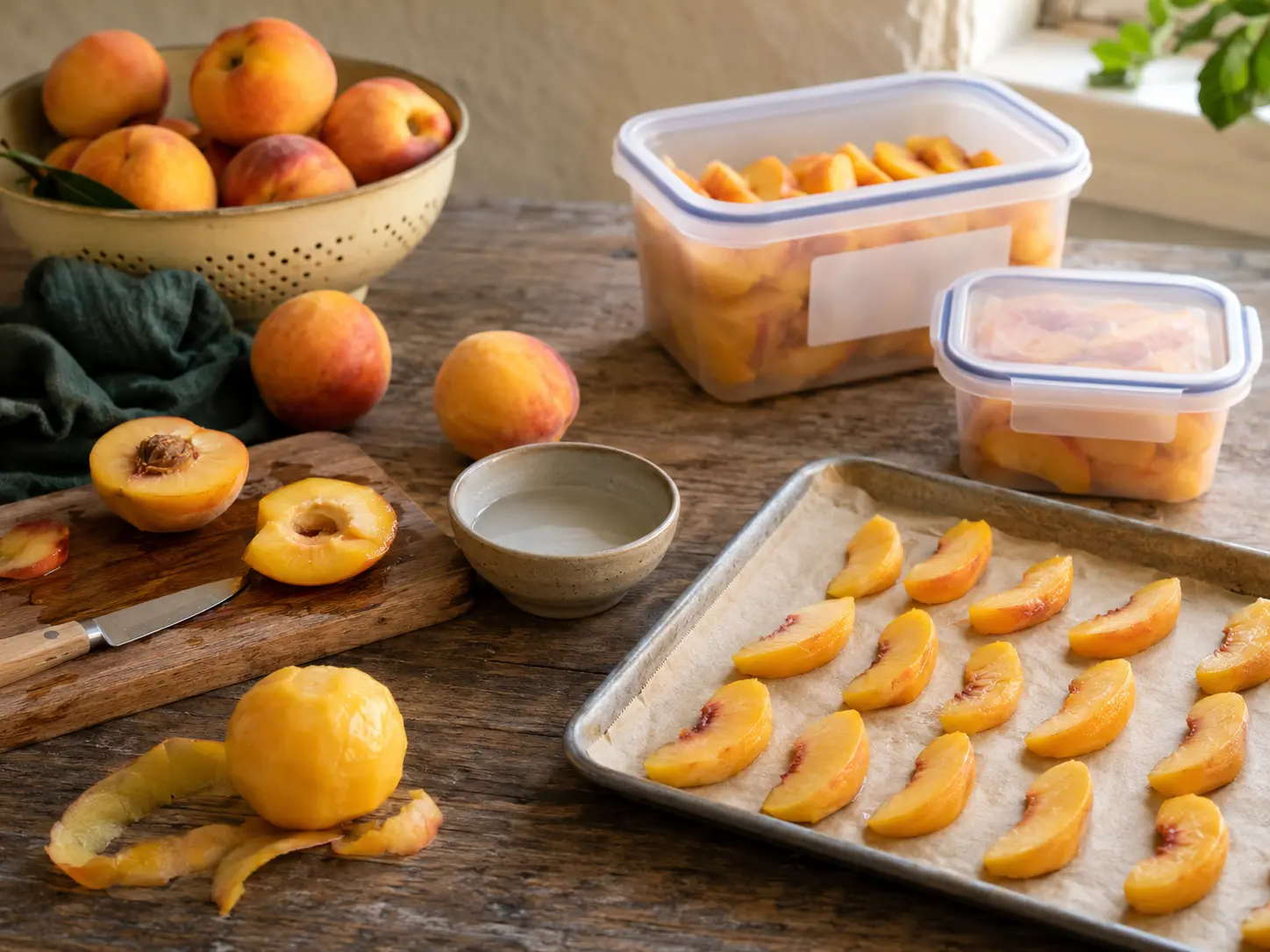
Yes. Sugar is not required to freeze peaches safely; it mainly helps maintain flavor, color, shape, and texture. For loose no-added-sugar slices, wash, peel, pit, and slice ripe peaches, use an ascorbic-acid anti-darkening treatment as directed, freeze the slices in one layer, then promptly package them airtight at 0°F (-18°C). For better texture, Illinois Extension specifically recommends an unsweetened pectin pack for peaches.
Print a clean copy or save it as a PDF for the kitchen.
What sugar does—and what it does not do
The National Center for Home Food Preservation says it is safe to freeze fruit without sugar. In frozen fruit, sugar is used for quality rather than safety: it helps retain flavor, color, shape, and texture.
That tradeoff matters. Unsweetened peaches may freeze harder, take longer to thaw, brown more readily, and feel softer after thawing. They are still useful for smoothies, cobblers, oatmeal, sauces, and other recipes where perfect fresh texture is not the goal.
Start with ripe, sound peaches
Choose well-ripened peaches that are fragrant and ripe but not bruised or mushy. Freezing preserves the quality you begin with; it cannot make underripe fruit sweeter or overripe fruit firmer.
Wash peaches gently under cold running water before peeling or cutting. The National Center's peach-freezing directions begin with peeled fruit. To loosen skins, place peaches in boiling water for 30 to 60 seconds, then transfer them quickly to cold water and slip off the skins. Remove the pits and cut the fruit into even slices.
Method 1: tray-freeze loose slices
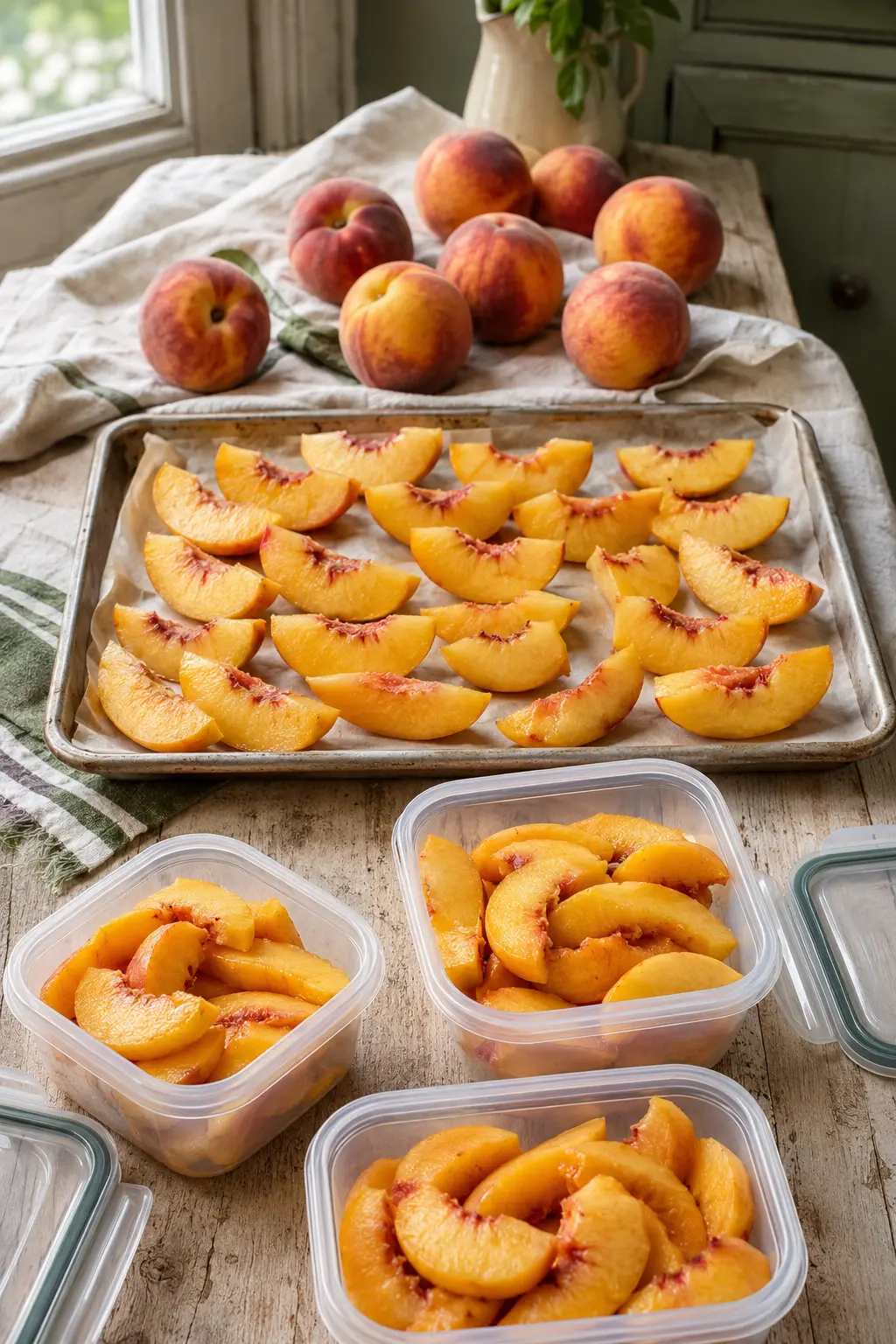
This is the simplest no-added-sugar method when you want to pour out only the amount a smoothie, breakfast, or bake needs. Oregon State Extension specifically allows peach slices to be frozen individually on a cookie sheet before packaging.
Peaches brown easily. Ascorbic acid, which is vitamin C, is more effective than citric acid or lemon juice at protecting color. Because commercial anti-darkening mixtures vary, follow the package directions rather than guessing a dose.
- Wash, peel, pit, and slice ripe peaches.
- Treat the cut fruit with pure ascorbic acid or a commercial anti-darkening mixture according to authoritative recipe or package directions.
- Drain well and arrange slices in one layer on a shallow tray so they do not touch.
- Freeze until solid.
- Promptly move the frozen slices into freezer bags or moisture- and vapor-resistant containers.
- Press out as much air as practical, seal, label with the date, and return to a 0°F (-18°C) freezer.
Method 2: use an unsweetened pectin pack
If texture matters more than loose pieces, Illinois Extension identifies pectin syrup as an unsweetened pack that works well for peaches. Pectin adds body without adding sugar.
To make the Illinois Extension pectin syrup, combine one package of powdered pectin with 1 cup of water in a saucepan. Bring it to a boil and boil for 1 minute. Remove it from the heat, add 1 3/4 cups more water, and let the syrup cool completely before it touches the prepared fruit.
- Prepare peeled, pitted peach slices and protect them from darkening as directed.
- Place the fruit in moisture- and vapor-resistant freezer containers.
- Cover with cooled pectin syrup, leaving room for expansion; Oregon State's peach guidance uses 1 inch of headspace for liquid packs.
- Keep the fruit below the liquid with a small piece of crumpled water-resistant wrap if needed.
- Seal, label, and freeze promptly at 0°F (-18°C).
A third option: 100% fruit juice
A no-added-sugar juice pack is useful when you do not need loose slices. University of Minnesota Extension lists 100% apple, white grape, pineapple, or orange juice as unsweetened alternatives, while Oregon State specifically notes that orange and pineapple juices help limit peach darkening because they contain ascorbic acid.
Pack prepared slices in a rigid freezer container, cover with chilled juice, leave 1 inch of headspace, hold the fruit under the liquid, seal, label, and freeze. Check the juice label: 'no added sugar' is not the same as sugar-free, because fruit juice naturally contains sugar.
How long will unsweetened peaches keep?
University of Minnesota Extension advises using frozen fresh fruit within 8 to 12 months for best quality when it is kept at 0°F (-18°C) or below. That is a quality window, not a claim that the fruit suddenly becomes unsafe on a particular date.
Unsweetened fruit generally loses quality faster than fruit packed in sugar or syrup. Use the oldest packages first, keep air out, and avoid freezer-temperature swings. Serve peach halves or slices while they still contain a few ice crystals; the National Center notes that partial thawing makes the normal texture change less noticeable.
Is this an Amish preservation method?
No. Freezing peaches without added sugar is a broadly used modern food-preservation method, not a uniquely Amish practice. Amish households are diverse, and technology choices vary by affiliation and local church district.
The useful plain-living principle is to preserve seasonal food in a form the household will actually eat. The methods and measurements in this guide come from the National Center for Home Food Preservation and university Extension sources, not cultural folklore.
Frequently asked questions
Is sugar necessary to freeze peaches safely?
No. The National Center for Home Food Preservation says fruit can be frozen safely without sugar. Sugar improves flavor, color, shape, and texture, but it is not the safety control in frozen peaches.
Can you freeze peaches with the skin on?
Peaches will physically freeze with their skins, but the National Center and Oregon State peach methods used here direct you to peel them first. Peel before freezing if you want a smoother result, because skins are harder to remove after thawing.
Does lemon juice stop frozen peaches from turning brown?
It can help, but Illinois Extension says lemon juice and citric acid are less effective than ascorbic acid and may change the fruit's flavor. Pure ascorbic acid or a commercial anti-darkening mixture used exactly as directed is the more dependable choice.
How long are frozen peaches good for?
For best quality, University of Minnesota Extension recommends using frozen fresh fruit within 8 to 12 months when stored continuously at 0°F (-18°C) or below. Unsweetened peaches may lose quality sooner than sugar- or syrup-packed fruit.
Should frozen peaches be thawed before baking?
Follow the recipe. For smoothies and cooked sauces, use them frozen. For baking, partially thaw and drain only when the recipe needs less extra liquid. For eating as fruit, partial thawing makes the softer frozen texture less noticeable.
Sources and further reading
- National Center for Home Food Preservation — Freezing Peaches or Nectarines
- National Center for Home Food Preservation — Dry or Tray Packing for Fruits
- National Center for Home Food Preservation — Resources for Home Preserving Peaches
- University of Minnesota Extension — How to Freeze Fruit Safely (reviewed 2025)
- Illinois Extension — Fruits: Types of Freezer Pack
- Illinois Extension — Freezing Methods
- Oregon State University Extension — Preserving Peaches
- FoodSafety.gov — Safe Ways to Handle and Clean Produce
- Elizabethtown College Young Center — Amish Studies FAQ
This article may use AI-assisted research organization and drafting. Claims involving safety, energy, or household costs are checked against the named sources above. Read about the founder and our editorial standards.