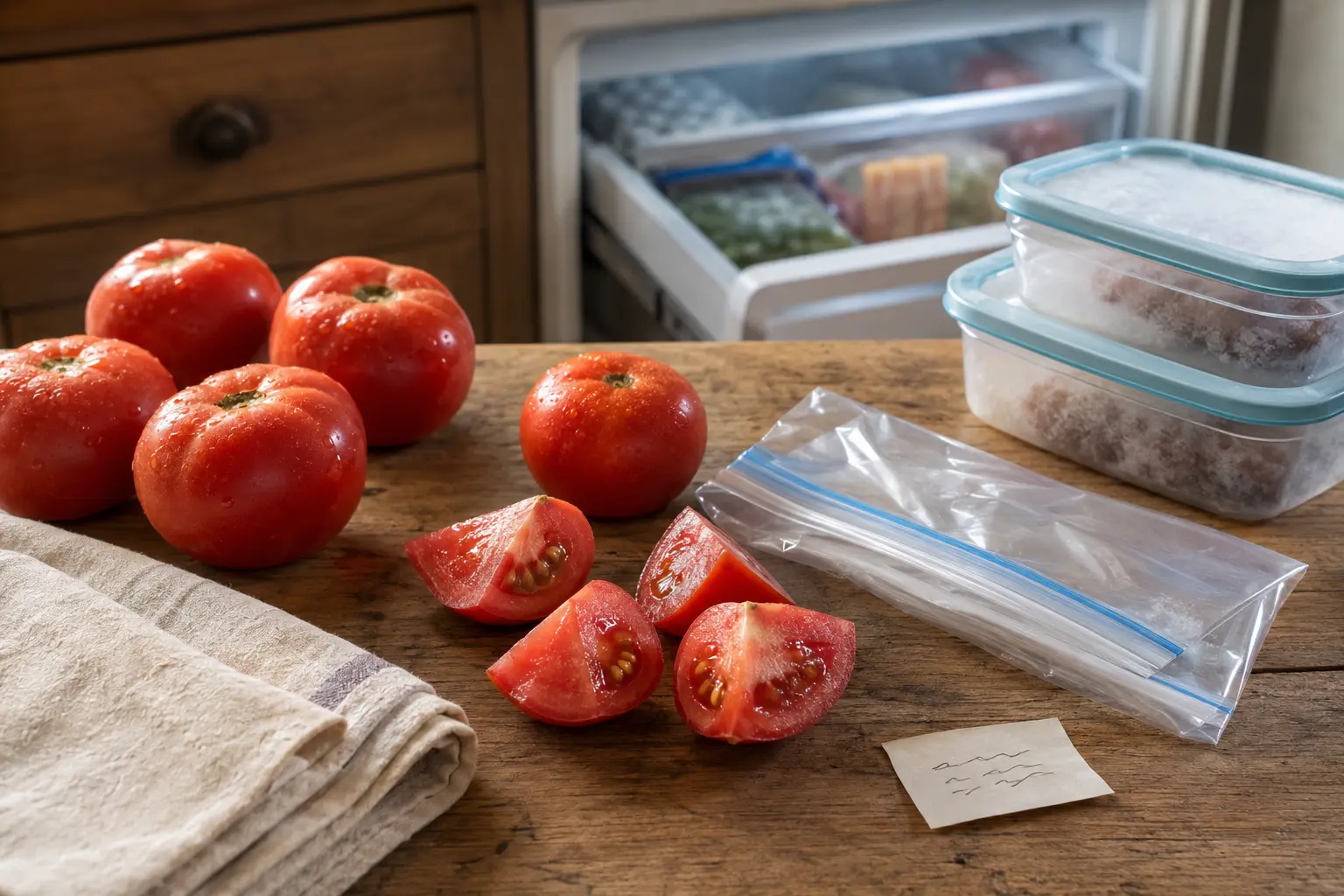
Yes. Unlike most vegetables, ripe tomatoes can be frozen without blanching, and the skins may stay on. Wash them under cool running water, remove the stems and cores, leave them whole or cut them into pieces, pack in freezer-safe bags or containers with room for expansion, label, and freeze at 0°F (-18°C) or below. After thawing they will be soft, so use them in cooked sauces, soups, stews, and casseroles rather than fresh salads.
Print a clean copy or save it as a PDF for the kitchen.
The fast skin-on method
Choose sound, ripe tomatoes. Gently rinse them under cool running water and dry with a clean towel. Do not use soap, bleach, sanitizer, or other household chemicals on produce.
Illinois Extension says tomatoes do not have to be blanched before freezing and that removing the skins is optional. The simplest method is therefore a clean, core, pack, and freeze routine.
- Remove stems and cut out the cores.
- Leave small tomatoes whole; leave larger tomatoes whole or cut them into halves or quarters.
- Pack them in freezer-safe bags or rigid freezer containers.
- Leave about 1 inch of headspace in a rigid container so the food can expand.
- Press excess air from bags, seal, label with the date, and freeze promptly.
Do you need to blanch or peel tomatoes first?
No blanching step is required for freezing ripe tomatoes. Some tested instructions call for a 30-second dip in boiling water because it makes the skins easy to remove, not because tomatoes must be fully blanched before freezing.
If you keep the skins on, they will toughen in the freezer but usually slip off easily after thawing. You can also run a frozen tomato briefly under cool water and pull away the curling skin. Peeling before freezing is a preference, not a requirement.
What frozen tomatoes are like after thawing
Frozen tomatoes do not return to a fresh, firm texture. Ice crystals disrupt their water-rich cells, so thawed tomatoes become soft and release liquid.
That makes them useful for tomato sauce, chili, soup, stew, curry, casserole, and other cooked dishes. They are a poor substitute for fresh sliced tomatoes in sandwiches or salads. Freeze portion sizes that match the meals you actually cook.
How to package them for better quality
Use moisture- and vapor-resistant freezer bags or freezer-safe rigid containers. Ordinary glass jars may break at freezer temperatures; if you use glass, choose containers specifically intended for freezing and follow the manufacturer’s headspace guidance.
Freeze manageable quantities quickly and keep the freezer at 0°F (-18°C) or below. University of Illinois Extension gives a best-quality range of 10 to 12 months for frozen tomatoes. University of Minnesota Extension recommends labeling packages and notes that frozen fruit is generally best within 8 to 12 months.
Freezing is not the same as canning
Frozen tomatoes do not need added acid because they remain frozen. Shelf-stable canned tomatoes are different: use a current tested recipe and follow its required bottled lemon juice or citric acid, jar size, processing method, time, and altitude adjustment.
Do not put raw tomatoes in a jar, seal it, and store it at room temperature. A freezer bag of tomatoes is a frozen food, not a canned product.
Is freezing tomatoes an Amish practice?
Freezing garden tomatoes is a broad modern home-preservation method, not a uniquely Amish practice. Technology use varies among Amish affiliations and communities, so it would be inaccurate to present one freezer routine as universal Amish tradition.
The useful principle is Amish-inspired rather than exclusively Amish: preserve a seasonal surplus so it replaces a future purchase, while using current food-safety guidance.
Frequently asked questions
Can you freeze whole tomatoes with the skins on?
Yes. Wash and core sound ripe tomatoes, pack them in freezer-safe bags or containers, remove excess air, label, and freeze. The skins usually loosen after freezing and thawing.
Do frozen tomatoes need lemon juice?
No acid is required for tomatoes that will remain frozen. Added bottled lemon juice or citric acid is part of tested shelf-stable canning instructions, which are a different preservation process.
Can frozen tomatoes be used in salad?
They will be soft and watery after thawing, so they are better for cooked sauces, soups, stews, chili, and casseroles than for fresh salads or sandwiches.
How long are frozen tomatoes good for?
For best quality, University of Illinois Extension recommends using frozen tomatoes within 10 to 12 months. Keep them continuously frozen at 0°F (-18°C) or below and label every package.
Sources and further reading
- University of Illinois Extension — Tomatoes: Freezing Tomatoes
- University of Illinois Extension — Preparing Tomatoes
- National Center for Home Food Preservation — Freezing Tomatoes
- University of Minnesota Extension — How to Freeze Fruit Safely, reviewed 2025
- FoodSafety.gov — Safe Ways to Handle and Clean Produce
This article may use AI-assisted research organization and drafting. Claims involving safety, energy, or household costs are checked against the named sources above. Read about the founder and our editorial standards.