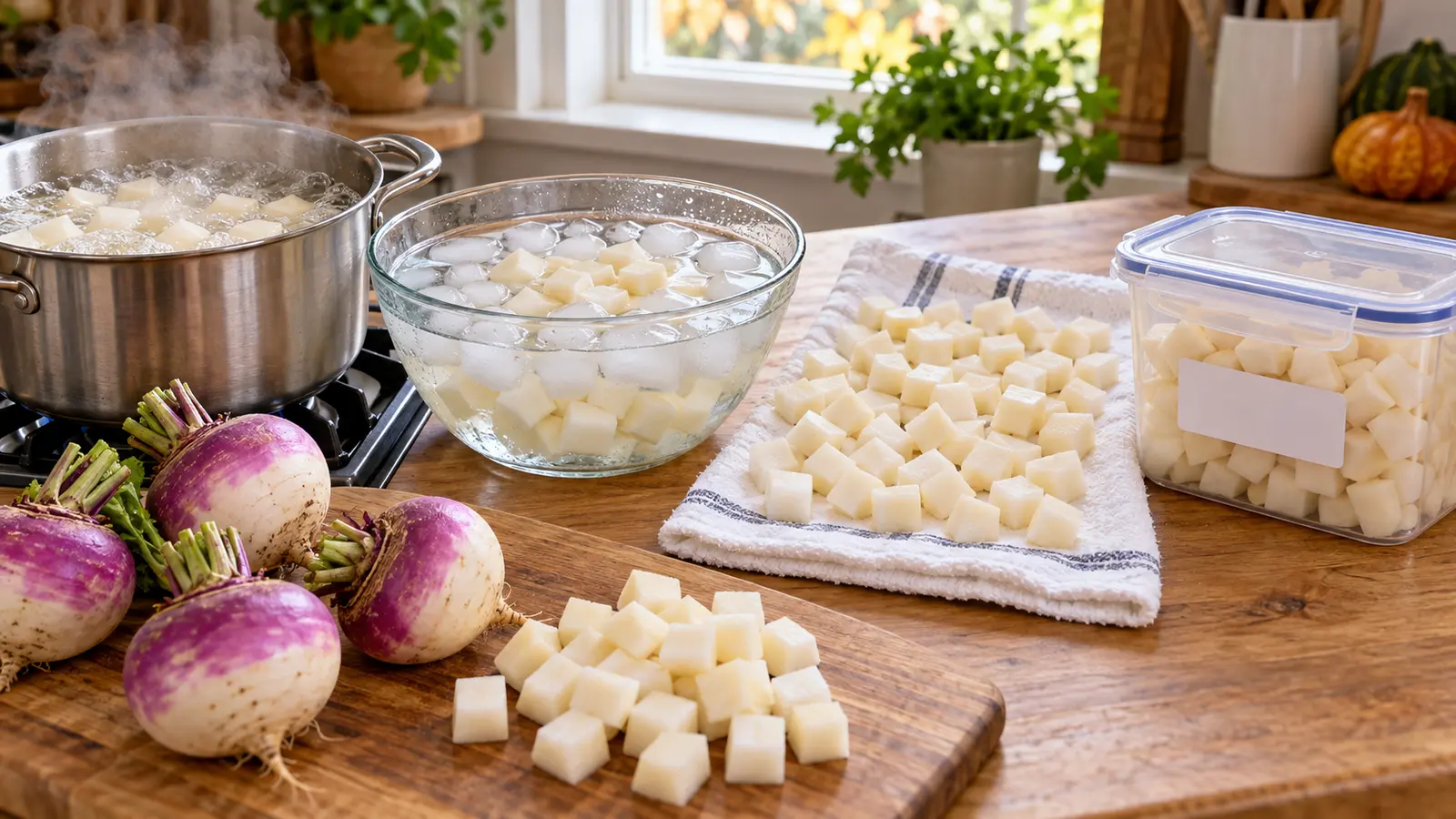
You can put raw turnips in the freezer, but blanching first gives more dependable color, flavor, and texture. This guide follows the National Center for Home Food Preservation method: choose small to medium firm turnips, peel and cut them into ½-inch cubes, water blanch for 2 minutes, cool promptly, drain, and pack with ½ inch of headspace. Some university Extension charts use a 3-minute water blanch; follow one complete published method rather than averaging the times.
Print a clean copy or save it as a PDF for the kitchen.
Saveable field method
How to freeze turnip cubes
Prepare, water blanch, cool, drain, and package turnip cubes using the National Center for Home Food Preservation method.
What you need
- Small to medium firm turnips
- Cold water and ice
- Moisture-vapor-resistant freezer containers or bags
- Labels and a permanent marker
- Vegetable brush and peeler
- Knife and cutting board
- Large pot with lid and blanching basket or colander
- Large bowl for ice water
- Timer
- Choose and wash
Select small to medium, firm turnips with a mild flavor. Remove the greens and scrub the roots under cold running water.
- Peel and cube
Peel the turnips, trim the root and stem ends, and cut the flesh into uniform ½-inch cubes so the pieces heat evenly.
- Water blanch for 2 minutes
Lower a manageable batch into vigorously boiling water. Cover, let the water return to a boil, then start the timer and blanch for 2 minutes.
- Cool promptly
Move the basket immediately into plenty of ice water. Cool for about the same 2 minutes to stop the cooking, changing the water or adding ice if it warms.
- Drain thoroughly
Lift out the cubes and drain well. Excess surface water freezes into extra ice and can reduce quality.
- Pack, label, and freeze
Pack the cooled cubes in freezer containers with ½ inch of headspace, or remove excess air from freezer bags. Seal, label with the date, and freeze promptly at 0°F or below.
Why blanch turnips before freezing?
Freezing slows food changes, but it does not stop every enzyme that affects vegetable flavor, color, texture, and nutrients. A brief heat treatment inactivates those enzymes, reduces surface microorganisms, and makes the cubes easier to pack.
Skipping blanching is mainly a quality choice, not a shortcut that makes turnips shelf-stable. Raw cubes may become duller, stronger-tasting, or softer during storage. Freezing also does not kill every harmful microorganism, so begin with sound roots, clean equipment, and a freezer held at 0°F (-18°C) or below.
Use small, firm roots and ½-inch cubes
Choose small to medium turnips that feel firm and have a mild flavor. Large, overmature roots can be woody, pithy, or sharp-tasting, and freezing cannot improve poor starting quality. Remove the greens before storing or preparing the roots because attached leaves draw moisture from them.
Wash under cold running water, peel, trim, and cut uniform ½-inch cubes. Uniform size matters because the blanching time assumes that heat can reach the center of each piece quickly. Do not substitute thick wedges or whole turnips and keep the same timer.
Follow the NCHFP 2-minute water-blanch method
Use about 1 gallon of water per pound of prepared vegetables. Lower a small batch into vigorously boiling water, cover the pot, and wait for the water to return to a boil. Start the 2-minute timer only then. If the water does not boil again within about 1 minute, the batch is too large for the pot.
As soon as the time ends, transfer the cubes to ice water for about 2 minutes. Drain thoroughly before packaging. Underblanching can stimulate enzyme activity and be worse for quality than no blanching, while overblanching needlessly softens the vegetable and causes flavor and nutrient loss.
Why do some trusted guides say 3 minutes?
The National Center for Home Food Preservation publishes a 2-minute water blanch for ½-inch turnip or parsnip cubes. The Pacific Northwest Extension freezing guide and University of Minnesota Extension chart publish a 3-minute water blanch, with Minnesota also listing 5 minutes for steam blanching.
These are complete Extension protocols, not a reason to split the difference. Choose one authoritative method and follow its piece size, heating method, timer, cooling, and packaging instructions together. This article and its step-by-step card use the NCHFP 2-minute water method throughout; if you choose the PNW or Minnesota method instead, follow that source's 3-minute directions from start to finish.
Pack small portions and use within 8 to 12 months
Pack cooled cubes in freezer-safe containers with ½ inch of headspace. For bags, press out as much air as practical without crushing the food. Label the contents and date, freeze promptly, and avoid loading the freezer with more unfrozen food than it can freeze quickly.
For best quality, use frozen vegetables within about 8 to 12 months at 0°F or below. Food kept continuously frozen can remain safe longer, but flavor, color, and texture gradually decline. Smaller meal-size packs reduce thawing time and help prevent waste.
How to cook frozen turnips
Frozen turnips are best in cooked dishes because thawing softens their cell structure. Add cubes directly from frozen to soups, stews, pot roasts, curries, or boiling water, allowing a little extra cooking time. They can also be cooked until tender and mashed with potatoes or parsnips.
For roasting, dry any surface ice, toss the still-frozen cubes with oil, and spread them on a hot pan without crowding. Expect a softer interior than fresh turnips. Avoid thawing them for a raw slaw or salad where crisp texture matters most.
Is freezing turnips an Amish practice?
No. Freezing turnips is a general modern preservation method, not a practice unique to Amish households. Amish affiliations and local church districts vary in their use of electricity and household technology, so freezer use should not be generalized across all communities.
Preserving seasonal roots and wasting less food fit a broadly frugal, old-fashioned mindset. The exact cube size, blanching time, cooling, packaging, and storage guidance here comes from the National Center and university Extension sources, not an unsupported cultural claim.
Frequently asked questions
Can you freeze raw turnips without blanching?
They will freeze, but their color, flavor, and texture are more likely to decline because the enzymes were not inactivated. For dependable quality, peel, cut into ½-inch cubes, and blanch before freezing.
How long should turnips be blanched before freezing?
The National Center for Home Food Preservation specifies 2 minutes in boiling water for ½-inch cubes. Some university Extension charts specify 3 minutes. Follow one complete source consistently rather than averaging the times.
Do you have to peel turnips before freezing them?
Yes for the published cube method. Wash, peel, trim, and cut small to medium firm roots into uniform ½-inch cubes before blanching.
Can turnip greens be frozen with the roots?
Prepare them separately. Tender greens use a leafy-green method and a different blanching time; do not pack them with root cubes under the 2-minute turnip-root schedule.
How long do frozen turnips keep?
For best quality, use properly prepared turnips within about 8 to 12 months when continuously stored at 0°F or below. Longer storage usually affects quality before safety.
Can you freeze mashed turnips?
Yes. Cook the turnips until tender, mash them, cool promptly, portion into freezer containers, leave room for expansion, label, and freeze. Expect a little liquid separation after thawing and stir during reheating.
Sources and further reading
- National Center for Home Food Preservation — Freezing Turnips or Parsnips
- National Center for Home Food Preservation — Blanching Vegetables
- Oregon State University Extension — Freezing Fruits and Vegetables
- University of Minnesota Extension — Preserving Food at Home: Freezing (reviewed 2025)
- Young Center for Anabaptist and Pietist Studies — Amish Diversity
This article may use AI-assisted research organization and drafting. Claims involving safety, energy, or household costs are checked against the named sources above. Read about the founder and our editorial standards.