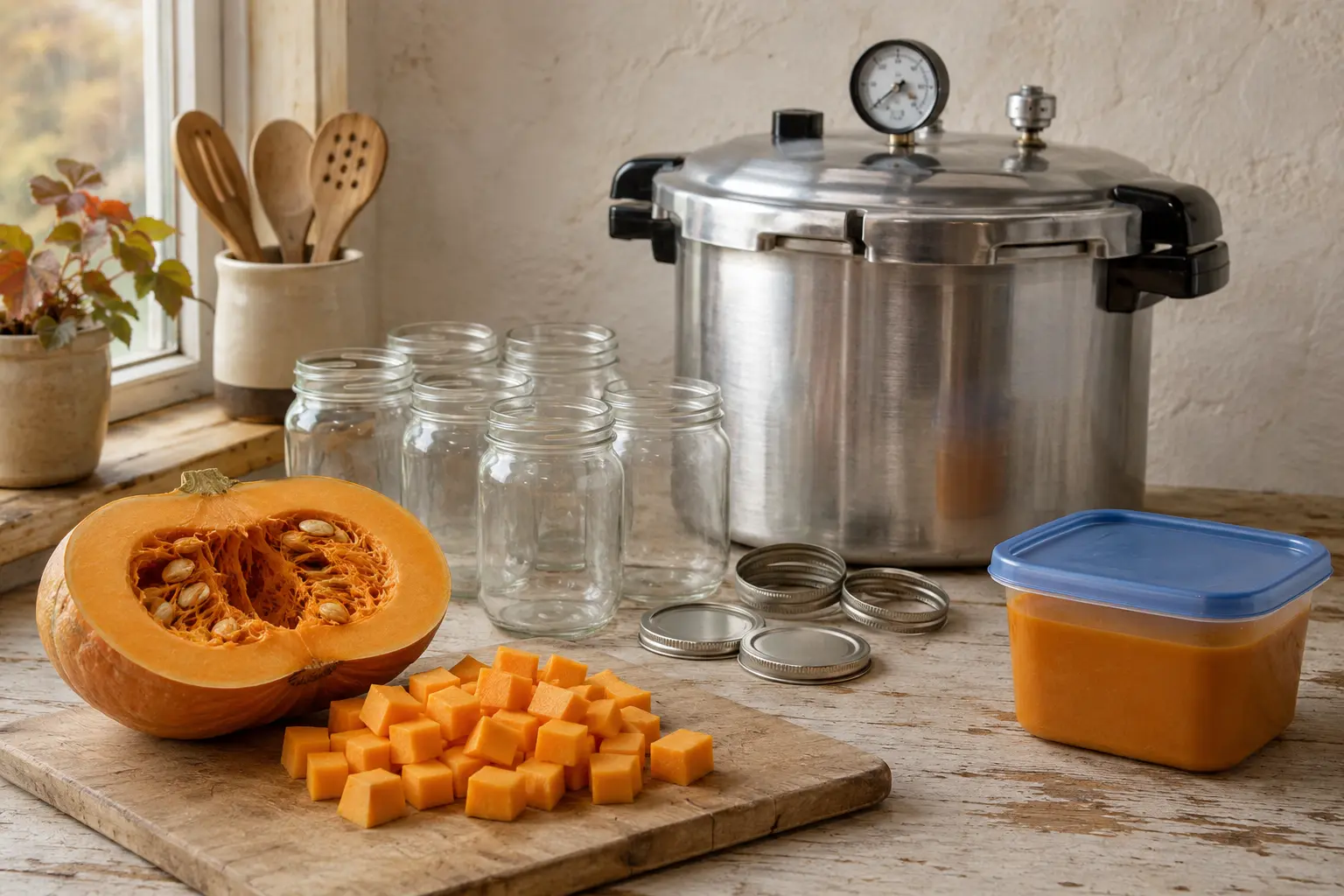
No. There is no currently recommended home-canning process for mashed or puréed pumpkin or winter squash—not even in a pressure canner. Purée varies too much in thickness for one tested process to guarantee adequate heat penetration throughout the jar. Freeze cooled pumpkin purée instead. If you want shelf-stable pumpkin, pressure-can peeled 1-inch cubes in liquid: process pints for 55 minutes or quarts for 90 minutes at the pressure required for your gauge type and altitude, then drain and purée the cubes when you are ready to cook.
Print a clean copy or save it as a PDF for the kitchen.
Saveable field method
How to preserve pumpkin safely when you want purée later
Choose between freezing finished purée and pressure-canning 1-inch cubes that can be mashed after opening.
What you need
- Mature sugar or pie pumpkin with a hard rind and sound flesh
- Water for cooking or hot-packing
- Freezer containers or pint or quart home-canning jars
- Oven, steamer, or cooking pot for the freezing option
- Blender, food processor, food mill, or potato masher
- A true stovetop pressure canner for shelf-stable cubes
- Jar lifter, canning funnel, bubble remover, and headspace measure
- Choose the storage method before cutting
Freeze purée if you want a ready-to-measure ingredient. Choose pressure-canned cubes only if shelf-stable storage matters and you have a true pressure canner. Do not plan to water-bath can or pressure-can purée.
- Prepare pumpkin for freezing
Wash the pumpkin, cut it safely, remove the stem, seeds, and stringy fibers, then cook the flesh until soft by baking, steaming, or simmering. Scoop the flesh from the rind and mash or purée it.
- Cool, package, and freeze the purée
Cool the purée promptly. Pack it into freezer-safe containers in useful recipe portions, leaving ½ inch of headspace for expansion, label it, and freeze. Thaw it in the refrigerator before use.
- Prepare cubes for shelf-stable canning
For the tested canning option, wash, seed, cut into 1-inch-wide slices, peel, and cut the flesh into uniform 1-inch cubes. Do not mash or purée.
- Boil and hot-pack the cubes
Boil the cubes in water for 2 minutes. Fill pint or quart jars with hot cubes and cooking liquid, leaving 1 inch of headspace. Follow the complete tested recipe and your canner manufacturer's operating instructions.
- Pressure-can, then purée after opening
Process pints for 55 minutes or quarts for 90 minutes at the pressure required for your gauge and altitude. After opening a jar for a recipe, drain the cubes and mash, sieve, or blend them to the consistency you need.
Why pumpkin purée has no recommended home-canning process
Pumpkin and winter squash are low-acid foods. A pressure canner is normally the correct equipment for low-acid vegetables, but equipment alone does not make every preparation safe. The food's thickness and the way heat travels through a jar are part of the tested process.
The National Center for Home Food Preservation explains that prepared pumpkin purées vary too much in viscosity from one batch to another. Older USDA directions for mashed squash were withdrawn after expert review, and no current home process has been established that covers that variation. A sealed lid does not prove that the coldest part of a thick jar received enough heat.
The easiest safe option: freeze the finished purée
Cook the pumpkin until soft, remove the rind, and mash or blend the flesh. Cool it promptly before packaging. Penn State Extension recommends rigid freezer containers with ½ inch of headspace; portioning the purée by the cup or by the amount your usual recipes need makes it easier to use later.
Freeze the containers promptly and thaw them in the refrigerator, not on the counter. Frozen purée may separate or release a little liquid as it thaws; stir it well or drain it to match the thickness your recipe expects. For best quality, plan to use frozen pumpkin or squash within about one year.
The shelf-stable option: pressure-can 1-inch cubes
The tested National Center method is for hot-packed cubes only. Choose mature pumpkin or winter squash with a hard rind and sound, stringless flesh. Wash it, remove seeds, cut 1-inch-wide slices, peel, cut 1-inch cubes, and boil the cubes in water for 2 minutes. Fill jars with hot cubes and cooking liquid, leaving 1 inch of headspace.
Process pints for 55 minutes or quarts for 90 minutes. The correct pressure depends on both your canner and altitude, so the processing time by itself is not a complete instruction. Use the full source recipe and your canner manual from start to finish.
- Dial-gauge, 0–2,000 feet: 11 pounds pressure.
- Dial-gauge, 2,001–4,000 feet: 12 pounds pressure.
- Dial-gauge, 4,001–6,000 feet: 13 pounds pressure.
- Dial-gauge, 6,001–8,000 feet: 14 pounds pressure.
- Weighted-gauge, 0–1,000 feet: 10 pounds pressure.
- Weighted-gauge, above 1,000 feet: 15 pounds pressure.
Pumpkin butter and pie filling are not shortcuts
Pumpkin butter is even thicker than plain purée, and there is no recommended home-canning process for it. Added sugar, spices, lemon juice, or vinegar do not turn an untested recipe into a safe shelf-stable product. Make pumpkin butter for short refrigerator storage or freeze it instead.
The same caution applies to an improvised jar of ready-made pumpkin pie filling. Can plain 1-inch cubes by the tested process, or freeze your finished purée or filling. Add dairy, eggs, thickeners, and the rest of the pie ingredients only when preparing the recipe for cooking.
What to do with pumpkin cubes after opening
Drain the jar, then mash, sieve, or blend the cubes. Because the cubes were packed in water, the result may be looser than commercial canned pumpkin. Let it drain in a fine-mesh strainer until it reaches the consistency your soup, bread, muffins, or pie recipe needs.
Do not use the canning liquid as evidence that the recipe can be modified. The cube size, liquid, jar size, headspace, time, pressure, and altitude adjustment work together as one tested process.
Is preserving pumpkin an Amish practice?
Growing, cooking, and preserving pumpkins are widespread North American household practices, not uniquely Amish traditions. The Young Center notes that Amish affiliations and local congregations differ in their rules and use of technology, so one household method should not be presented as universal Amish custom.
This guide is Amish-inspired only in its plain-living goal of using a seasonal harvest carefully. Its safety limits, cube size, headspace, processing times, pressure, and freezing advice come from current USDA-based and university Extension guidance—not folklore or an old family method.
Frequently asked questions
Can you pressure-can pumpkin purée?
No. There is no currently recommended home process for pressure-canning mashed or puréed pumpkin or winter squash. Pressure-can 1-inch cubes by the tested method, or freeze the finished purée.
Can you water-bath can pumpkin purée?
No. Pumpkin is a low-acid food, and a boiling-water bath is not suitable for plain pumpkin. Purée also lacks a tested home pressure-canning process.
How long do you pressure-can pumpkin cubes?
Process hot-packed 1-inch cubes for 55 minutes in pints or 90 minutes in quarts, using the pressure required for your gauge type and altitude. Follow the complete tested recipe.
Can you can pumpkin butter if you add lemon juice?
No tested home-canning process is recommended for pumpkin butter. Added acid does not validate an improvised recipe because acidity, thickness, and heat penetration all matter. Refrigerate briefly or freeze it.
Can butternut squash purée be canned?
No. The same restriction applies to mashed or puréed winter squash. Freeze the purée or pressure-can peeled 1-inch cubes using the tested pumpkin-and-winter-squash process.
What should you do with pumpkin purée canned by an untested method?
Do not taste it or rely on the seal. If you cannot verify that a current tested process was followed—and no current process exists for home-canned pumpkin purée—the CDC advises throwing the food out.
Sources and further reading
- National Center for Home Food Preservation — Pumpkins and Winter Squash, Cubed
- National Center for Home Food Preservation — Vegetables and Fruits Canning FAQs
- Penn State Extension — Preserving Pumpkin Purée Safely at Home (September 30, 2024)
- Penn State Extension — What Should I Do With All My Home Canned Food? (July 6, 2026)
- NC State Extension — Preserving Winter Squash and Pumpkins (December 12, 2024)
- CDC — Home-Canned Foods and Botulism (April 25, 2024)
- Young Center for Anabaptist and Pietist Studies — Amish Studies
This article may use AI-assisted research organization and drafting. Claims involving safety, energy, or household costs are checked against the named sources above. Read about the founder and our editorial standards.