No. Plain green beans are a low-acid food, so a boiling-water bath cannot reach the temperature needed for safe shelf-stable canning. Use a true stovetop pressure canner and a current tested recipe: process pints for 20 minutes and quarts for 25 minutes at the pressure required for your gauge type and altitude. If you do not own a pressure canner, freeze the beans or use a complete tested pickled dilled-bean recipe; adding a splash of vinegar to ordinary beans is not an acceptable substitute.
Print a clean copy or save it as a PDF for the kitchen.
Saveable field method
How to pressure-can plain green beans using the tested USDA method
Prepare, pack, and process plain snap, Italian, green, or wax beans with the correct jar size, headspace, time, pressure, and altitude adjustment.
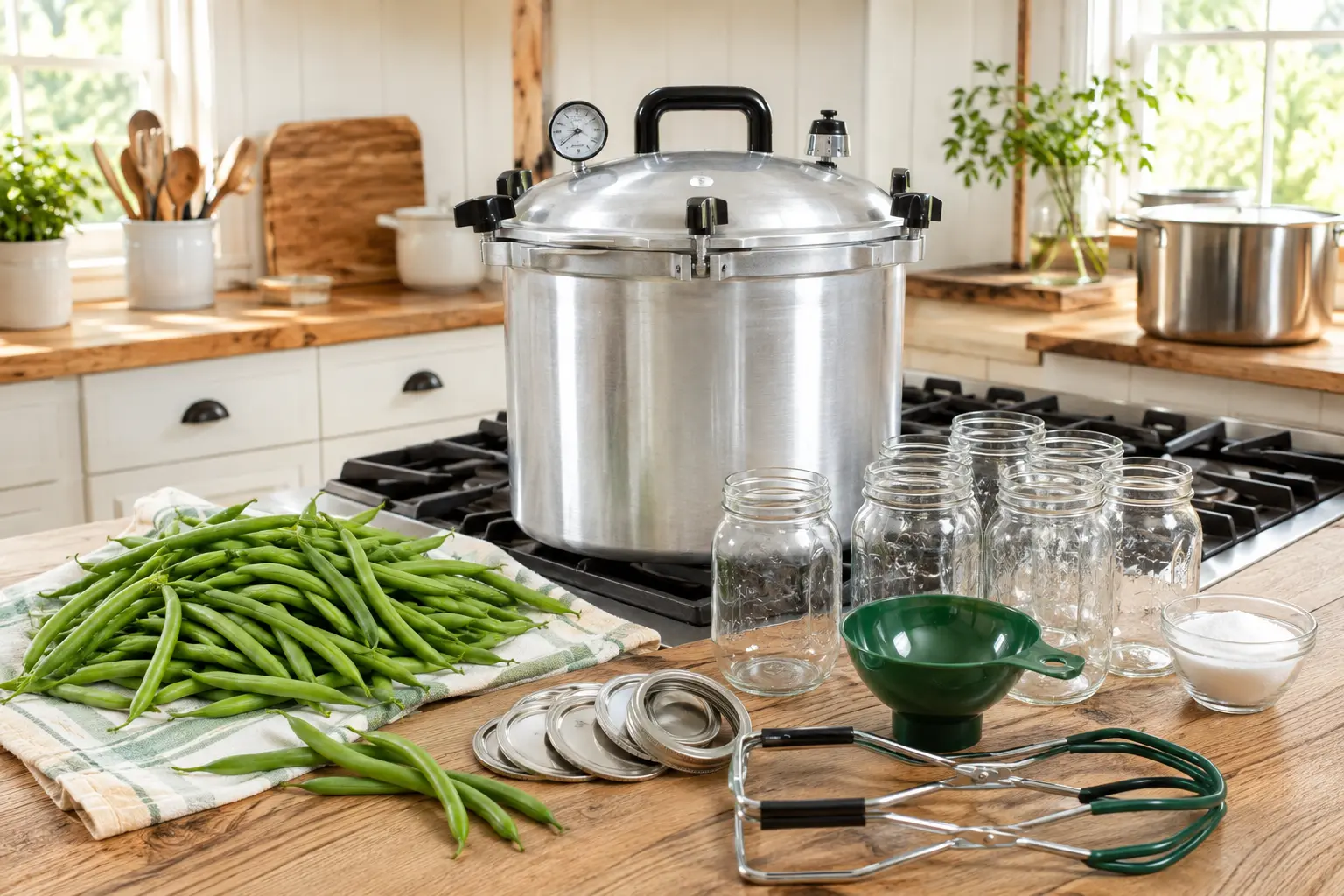
What you need
- Filled but tender, crisp green, wax, snap, or Italian bean pods
- Boiling water
- Canning or pickling salt, optional
- A true stovetop pressure canner that holds at least four quart jars upright
- Pint or quart home-canning jars with two-piece lids
- Jar lifter, canning funnel, bubble remover, and headspace measure
- A current altitude reading and the pressure table for your gauge type
- Inspect and wash the beans
Choose filled but tender, crisp pods. Discard diseased, rusty, bruised, or decaying beans. Wash the sound beans under cool running water and trim the ends.
- Cut or leave whole
Leave the beans whole or cut or snap them into 1-inch pieces. Keep the preparation consistent so the tested packing directions still apply.
- Choose hot pack or raw pack
For hot pack, cover the beans with boiling water, boil 5 minutes, and fill jars loosely. For raw pack, fill jars tightly with raw prepared beans.
- Add boiling water and leave headspace
Cover the beans with boiling water and leave 1 inch of headspace. Salt is optional for flavor: up to ½ teaspoon per pint or 1 teaspoon per quart.
- Load and vent the pressure canner
Apply lids as directed by the manufacturer, keep jars upright, and follow the complete pressure-canner operating procedure. Vent a steady stream of steam for the full time required by USDA guidance before pressurizing.
- Process for the tested time and pressure
Process pints for 20 minutes or quarts for 25 minutes at the pressure required for your gauge and altitude. If pressure drops below the target, return to pressure and restart the full processing time.
Why a boiling-water bath is not safe for plain green beans
Green beans are low-acid, with a pH well above the 4.6 cutoff used for boiling-water canning. Boiling water reaches about 212°F at sea level, while a pressure canner raises the temperature of steam to the range needed for a tested low-acid process. Extending the boiling-water time does not turn it into pressure canning.
The CDC says low-acid foods are the most common sources of botulism linked to home canning and specifically states that boiling-water canners do not protect low-acid foods. The toxin cannot reliably be seen, smelled, or tasted. A lid that seals is evidence of a vacuum—not proof that the food received a safe process.
The tested processing times for plain green beans
The National Center for Home Food Preservation gives the same time for hot-packed and raw-packed snap, Italian, green, and wax beans: 20 minutes for pints and 25 minutes for quarts. Pressure changes with altitude and with the canner's gauge type, so time alone is incomplete.
Identify your canner as dial-gauge or weighted-gauge before starting, determine your altitude, and use the matching line below. A dial gauge should be checked for accuracy according to current Extension and manufacturer guidance.
- Dial-gauge, 0–2,000 feet: 11 pounds pressure.
- Dial-gauge, 2,001–4,000 feet: 12 pounds pressure.
- Dial-gauge, 4,001–6,000 feet: 13 pounds pressure.
- Dial-gauge, 6,001–8,000 feet: 14 pounds pressure.
- Weighted-gauge, 0–1,000 feet: 10 pounds pressure.
- Weighted-gauge, above 1,000 feet: 15 pounds pressure.
Hot pack versus raw pack
Both packs are tested. For hot pack, cover prepared beans with boiling water, boil for 5 minutes, fill jars loosely, and cover with the hot cooking liquid. For raw pack, place raw prepared beans tightly in the jars and cover with boiling water. Both methods require 1 inch of headspace.
Canning salt is optional and is used for flavor, not safety. The National Center allows up to ½ teaspoon per pint or 1 teaspoon per quart. Do not thicken the liquid, dry-pack the beans, add bacon or fat, or change the jar size unless a current tested recipe explicitly gives that version.
A pressure cooker is not automatically a pressure canner
Use equipment designed and tested for pressure canning. The CDC describes a recommended canner as one large enough to hold at least four 1-quart jars upright on a rack. Small pressure cookers and electric multicookers do not automatically meet that standard; the CDC says not to use an electric multicooker for low-acid canning even when it has a canning button.
Follow the canner manufacturer's operating instructions together with the tested food process. Venting, maintaining pressure, natural cooling, and opening the lid safely are part of the process. If the pressure falls below the target at any point, bring it back to pressure and restart the full timed process.
What to do without a pressure canner
Freezing is the simplest plain-bean alternative. Blanch prepared green beans for 3 minutes, cool promptly, drain, package, and freeze at 0°F or below. This preserves the familiar unpickled flavor without pretending a water-bath jar is shelf-stable.
For a shelf-stable boiling-water option, use a complete tested dilled-bean or pickled-bean recipe. The National Center's dilled beans use a measured 1:1 mixture of 5%-acidity white vinegar and water plus the specified salt and jar size. Do not turn plain beans into a guessed pickle by adding an arbitrary splash of vinegar.
Are home-canned green beans an Amish practice?
Home preservation is common across many American households and communities, including some Amish households, but pressure-canning green beans is not a uniquely Amish method. Amish affiliations and church districts differ in their use of technology and equipment, so one canning routine should not be presented as universal Amish tradition.
The plain-living goal—saving a garden surplus for later—is Amish-inspired here. The equipment, times, pressures, altitude adjustments, and safety limits come from USDA-based and university Extension guidance, not folklore or an old family recipe.
Frequently asked questions
Can you water bath green beans for three hours?
No. A longer boiling-water process does not reach pressure-canning temperatures and is not a tested safe method for plain green beans. Use a true pressure canner or choose freezing or a tested pickled-bean recipe.
How long do you pressure-can green beans?
Process pints for 20 minutes and quarts for 25 minutes. You must also maintain the pressure specified for your gauge type and altitude; time without the correct pressure is not a complete process.
Can you add vinegar and water bath can green beans?
Only by following a complete tested pickled-bean recipe with its exact vinegar acidity, water ratio, ingredients, jar size, headspace, time, and altitude adjustment. An improvised splash of vinegar is not enough.
Is salt required when canning green beans?
No. In the tested plain-bean recipe, canning salt is optional for flavor. Leaving it out does not replace or change the required pressure, processing time, headspace, or other directions.
Can an electric pressure cooker can green beans?
Do not use an electric multicooker for this job. The CDC says not to use one for low-acid canning even if it has a canning setting. Use a recommended stovetop pressure canner large enough to hold at least four quart jars upright.
What if home-canned green beans were processed in a water bath?
Do not taste them and do not treat a sealed lid as proof of safety. If you cannot verify that current safe canning guidance was followed, the CDC advises throwing the food out.
Sources and further reading
- National Center for Home Food Preservation — Beans, Snap and Italian
- Penn State Extension — How to Preserve Green and Yellow Beans (May 18, 2026)
- CDC — Home-Canned Foods and Botulism (April 25, 2024)
- National Center for Home Food Preservation — Dilled Beans
- University of Minnesota Extension — Growing Beans
- Young Center for Anabaptist and Pietist Studies — Amish Diversity
This article may use AI-assisted research organization and drafting. Claims involving safety, energy, or household costs are checked against the named sources above. Read about the founder and our editorial standards.