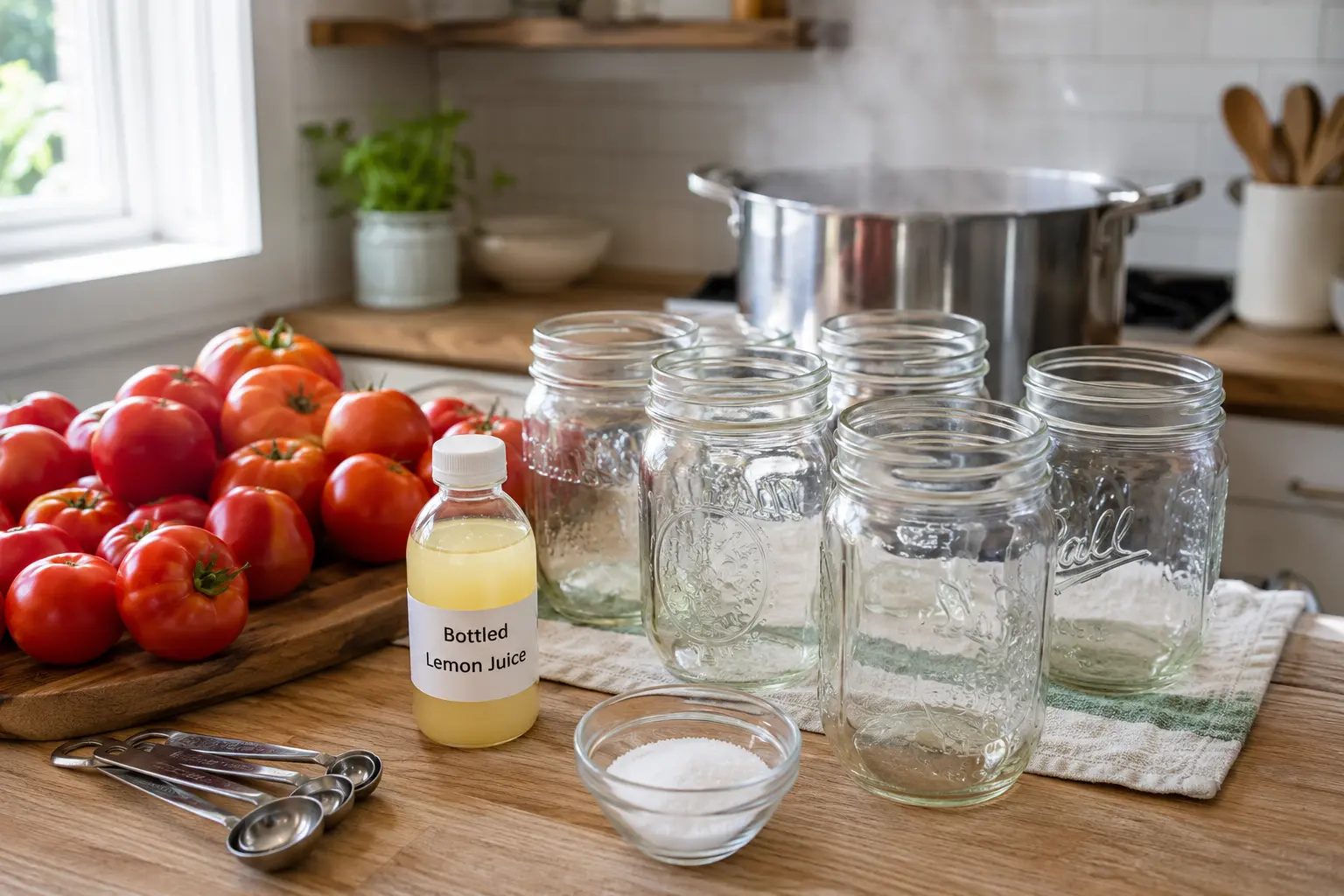
Yes. For whole, crushed, or juiced tomatoes, current USDA-based directions require acid in every jar. Add 1 tablespoon of commercially bottled lemon juice or ¼ teaspoon of food-grade citric acid to each pint; use 2 tablespoons bottled lemon juice or ½ teaspoon citric acid for each quart. Add the measured acid directly to the empty jar before filling, then follow a current tested recipe for the exact tomato product, jar size, pack style, processing method, time, and altitude. Fresh-squeezed lemon juice is not a safe substitute because its acidity varies.
Print a clean copy or save it as a PDF for the kitchen.
Saveable field method
How to acidify tomatoes within a tested canning recipe
Measure a standardized acid into each jar, then complete every remaining step in a current USDA or university Extension tomato-canning recipe.
What you need
- Sound, disease-free, preferably vine-ripened tomatoes
- Commercially bottled lemon juice or food-grade citric acid
- Standard measuring spoons
- Clean home-canning jars and new lids prepared as directed by the manufacturer
- The canner required by the tested recipe
- Choose one complete tested recipe
Select a current USDA, National Center for Home Food Preservation, or university Extension recipe for the exact product you are making. Do not combine the acid amount from this guide with an improvised sauce or salsa recipe.
- Sort and prepare the tomatoes
Use sound tomatoes and follow the recipe's directions for washing, peeling, coring, cutting, heating, and pack style. Do not can tomatoes from dead or frost-killed vines.
- Measure acid into each empty jar
For a pint, add 1 tablespoon bottled lemon juice or ¼ teaspoon citric acid. For a quart, add 2 tablespoons bottled lemon juice or ½ teaspoon citric acid.
- Fill to the recipe's headspace
Add the prepared tomatoes or juice exactly as directed, remove bubbles when instructed, and leave the stated headspace. Do not add flour, cornstarch, rice, pasta, cream, extra vegetables, or other untested ingredients.
- Process for the full adjusted time
Use the canner, jar size, process time, pressure when applicable, and altitude adjustment specified by the tested recipe. Added acid does not replace heat processing.
Why tomatoes still need added acid
Tomatoes sit close to the dividing line between acid and low-acid foods. Their acidity changes with variety, growing conditions, maturity, and the form of the finished product. University of Minnesota Extension, whose tomato-canning guidance was reviewed in 2026, says the USDA recommends adding acid to all home-canned tomatoes and tomato products regardless of the canning method.
The safety target is a pH of 4.6 or below, a level that prevents growth of Clostridium botulinum. The CDC notes that some tomatoes can be low-acid and that improperly canned foods can contain botulinum toxin without a reliable warning in appearance, smell, or taste. Acidification is one control inside a complete tested process; it is not an optional flavor adjustment.
Exact lemon juice and citric acid amounts
The National Center for Home Food Preservation gives the same jar-by-jar amounts for whole, crushed, and juiced tomatoes. Put the acid directly into each jar before filling so no jar is missed. Use standard measuring spoons, not an ordinary table spoon.
Citric acid usually changes the flavor less than lemon juice. If the finished tomatoes taste sharper than you prefer, the National Center says sugar may be added to offset the acid taste, but the required acid must not be reduced.
- Pint jar: 1 tablespoon commercially bottled lemon juice or ¼ teaspoon food-grade citric acid.
- Quart jar: 2 tablespoons commercially bottled lemon juice or ½ teaspoon food-grade citric acid.
- Vinegar alternative: 2 tablespoons of 5%-acidity vinegar per pint or 4 tablespoons per quart; expect a more noticeable flavor change.
Why bottled lemon juice is different from fresh
Commercially bottled lemon juice is standardized for acidity. Fresh lemons vary by variety, ripeness, storage, and individual fruit, so a tablespoon of fresh juice does not provide the same dependable safety control. University of Minnesota Extension specifically says not to use freshly squeezed lemon juice for this job.
Food-grade citric acid is the most neutral-tasting alternative. If using vinegar under the general tomato acidification directions, the label must state 5% acidity. Do not use homemade vinegar or a bottle with unknown acidity. For salsa, ketchup, barbecue sauce, and other mixed products, follow the acid type and amount in that exact tested recipe rather than substituting from this general tomato guide.
Pressure canning does not automatically remove the acid step
Some USDA tomato directions offer both boiling-water and pressure-canning options. The National Center explains that these are equal alternative processes developed for the acidified product. When one of those recipes says to acidify, the step is still required under the pressure option; those pressure schedules were not developed for tomatoes without added acid.
That does not mean every tomato mixture can move between canners. Low-acid additions such as peppers, onions, okra, meat, or extra vegetables change the product. Use a tested recipe written for that exact mixture. Never guess a pressure, time, jar size, or acid amount from a different recipe.
Acid is not a substitute for processing
Adding lemon juice and closing a hot jar does not create a shelf-stable product. The filled jars must still receive the complete boiling-water or pressure process specified by the tested recipe, including the correct jar size, headspace, pack style, time, and altitude adjustment.
Do not thicken tomato products with flour, cornstarch, rice, pasta, or cream before canning unless a tested recipe explicitly includes that ingredient. Thickness can interfere with heat penetration. If you forgot the acid or changed the recipe, do not place the jars on a pantry shelf and do not taste them to decide whether they are safe. Contact your local Extension office for batch-specific advice; when the process is uncertain, discard the product.
Are canned tomatoes an Amish tradition?
Home canning is used in many American households and communities, including some Amish households, but tomato acidification is a modern food-safety requirement based on USDA research—not a uniquely Amish practice. The Young Center for Amish Studies also cautions that Amish affiliations and local church districts differ substantially.
Plain & Frugal treats the waste-reducing goal as Amish-inspired while taking every canning measurement from current research-based guidance. An old family recipe can be meaningful, but it should be compared with a current tested formula before anyone treats it as shelf-stable.
Frequently asked questions
Do you need lemon juice when pressure canning tomatoes?
Yes when the tested USDA tomato recipe calls for acidification. The National Center states that the pressure options for whole, crushed, or juiced tomatoes were developed for acidified tomatoes, so the lemon juice or citric acid step still applies.
Can I use fresh lemon juice when canning tomatoes?
No. Use commercially bottled lemon juice because its acidity is standardized. Fresh-squeezed juice varies and is not a dependable substitute for the tested acidification amount.
Can citric acid replace bottled lemon juice?
Yes. Use ¼ teaspoon food-grade citric acid per pint or ½ teaspoon per quart for whole, crushed, or juiced tomatoes. It usually changes the flavor less than lemon juice.
Can vinegar replace lemon juice in canned tomatoes?
For the National Center's general whole, crushed, and juiced tomato directions, use 2 tablespoons of 5%-acidity vinegar per pint or 4 tablespoons per quart. Vinegar changes flavor more. In salsa or another mixed recipe, use only the acid specified by that tested recipe.
Do heirloom tomatoes need added acid?
Yes. University of Minnesota Extension says heirloom tomatoes should receive the same acidification treatment as other varieties because their acidity is not predictably safer.
Does lemon juice make tomatoes safe without a canner?
No. Acidification is only one part of a tested canning process. The jars still need the specified heat process, jar size, headspace, pack style, time, and altitude adjustment.
Sources and further reading
- National Center for Home Food Preservation — Canning Tomatoes, Introduction
- University of Minnesota Extension — Canning at Home: Tomatoes (reviewed 2026)
- CDC — Home-Canned Foods and Botulism (April 25, 2024)
- Penn State Extension — Canning and Freezing Questions and Answers (April 5, 2026)
- Young Center for Anabaptist and Pietist Studies — Amish Diversity
This article may use AI-assisted research organization and drafting. Claims involving safety, energy, or household costs are checked against the named sources above. Read about the founder and our editorial standards.