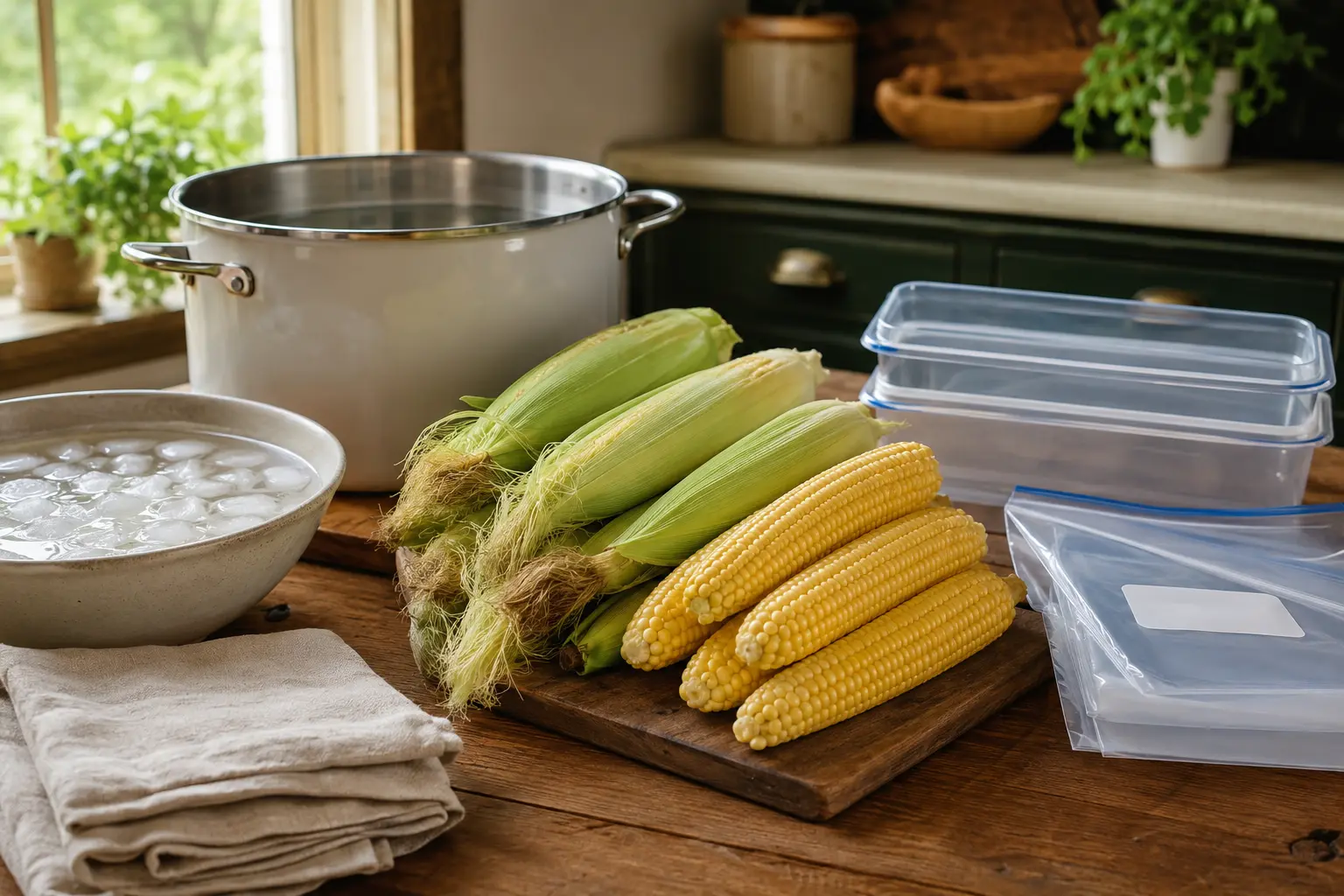
You can physically freeze corn on the cob without blanching, but it is not the tested best-quality method for longer storage. The National Center for Home Food Preservation recommends water-blanching small ears for 7 minutes, medium ears for 9 minutes, and large ears for 11 minutes, then cooling them promptly and completely, draining, packaging, and freezing at 0°F (-18°C) or below.
Print a clean copy or save it as a PDF for the kitchen.
Why blanch corn before freezing it?
Freezing slows food changes, but it does not stop every enzyme. Blanching slows or stops the enzyme activity that can damage a vegetable’s flavor, color, texture, and nutrients during frozen storage.
This is mainly a quality step, not permission to begin with dirty or spoiled corn. Choose tender, freshly gathered ears, remove the husks and silk, wash the corn under cold running water, and use clean equipment. Freezing does not destroy every microorganism that may be present.
The tested method for whole corn on the cob
Bring a large pot of water to a vigorous boil. Use enough water that it returns to a boil within 1 minute after the corn goes in. Cover the pot and start timing when the water returns to a boil, working in batches that the pot can handle.
The National Center for Home Food Preservation bases the blanching time on the diameter of the ear. Cooling fully after blanching prevents continued cooking and the off flavor sometimes described as “cobby.”
- Blanch small ears, 1¼ inches or less in diameter, for 7 minutes.
- Blanch medium ears, 1¼ to 1½ inches in diameter, for 9 minutes.
- Blanch large ears, more than 1½ inches in diameter, for 11 minutes.
- Move the ears immediately into plenty of ice water and cool them completely.
- Drain and dry the corn well so extra water does not freeze around it.
- Pack in freezer bags or rigid freezer containers, remove excess air, seal, label, and freeze promptly.
Freezing kernels saves space
If you mostly use corn in soup, chili, cornbread, casserole, or skillet meals, freezing kernels is usually more practical than storing whole cobs. The tested whole-kernel method uses a shorter 4-minute water blanch.
Cool the ears promptly in ice water, drain, then cut the kernels from the cob at about two-thirds of their depth. Pack the kernels in freezer-safe bags or containers, leaving ½ inch of headspace in rigid containers. Flattened bags stack neatly and make it easier to thaw only what a recipe needs.
What happens if you freeze the corn raw?
Raw corn will become frozen, but the enzymes were not inactivated first. That makes loss of sweetness, fresh flavor, color, and texture more likely during storage. Online shortcuts that say to put unshucked ears directly in the freezer are not the tested method used by the National Center or the university Extension sources in this guide.
If you already froze sound corn without blanching, it does not automatically need to be discarded. Keep it continuously frozen at 0°F (-18°C), use it sooner rather than later, and expect lower quality. For the next batch, blanching gives the more dependable result.
How long it keeps and how to cook it
For properly prepared and packaged fruits and vegetables held at 0°F (-18°C), the National Center gives an approximate best-quality range of 8 to 12 months. Label each package with the preparation and date, and use the oldest corn first.
Most frozen vegetables can go directly into cooking, but whole corn on the cob is an exception: the National Center advises partially thawing it so the cob heats through before the kernels overcook. Do not let thawed or cooked corn sit around, because its texture becomes soggy.
Is freezing corn specifically an Amish practice?
No. Freezing sweet corn is a modern home-preservation method used by households across the United States, not a uniquely Amish tradition. Technology rules also vary among Amish affiliations and church districts, so one freezer routine should not be described as universal Amish practice.
The broadly useful, Amish-inspired principle is to preserve a seasonal surplus for meals you will actually cook. The blanching times themselves come from current home-preservation guidance, not folklore.
Frequently asked questions
Can you freeze corn on the cob in the husk?
The tested method cited here removes the husk and silk, washes the corn, blanches it for the time required by ear size, cools it completely, drains, packages, and freezes it. Freezing unprepared ears in their husks is not that tested method.
How long should you blanch corn on the cob?
Water-blanch small ears for 7 minutes, medium ears for 9 minutes, and large ears for 11 minutes. Measure the ear diameter and cool the corn promptly and completely afterward.
Do you need to thaw frozen corn on the cob before cooking?
Partially thaw whole frozen cobs before cooking so the cob can heat through by the time the kernels are ready. Frozen loose kernels can usually go directly into a cooked dish.
How long does frozen corn stay good?
Properly prepared fruits and vegetables generally keep their best quality for about 8 to 12 months at 0°F (-18°C). Continuous freezing keeps food safe longer, but quality gradually declines.
Can you freeze corn kernels without blanching?
Raw kernels will freeze, but for dependable long-term quality the tested method is to blanch the ears for 4 minutes before cooling, draining, cutting off the kernels, packaging, and freezing.
Sources and further reading
- National Center for Home Food Preservation — Freezing Corn
- National Center for Home Food Preservation — Blanching Vegetables
- National Center for Home Food Preservation — Frozen Food Storage Times
- National Center for Home Food Preservation — Thawing and Preparing Foods
- Penn State Extension — Preserving Sweet Corn Successfully, June 17, 2025
- University of Illinois Extension — Preparing Corn
- Elizabethtown College Young Center — Amish Studies FAQ
This article may use AI-assisted research organization and drafting. Claims involving safety, energy, or household costs are checked against the named sources above. Read about the founder and our editorial standards.