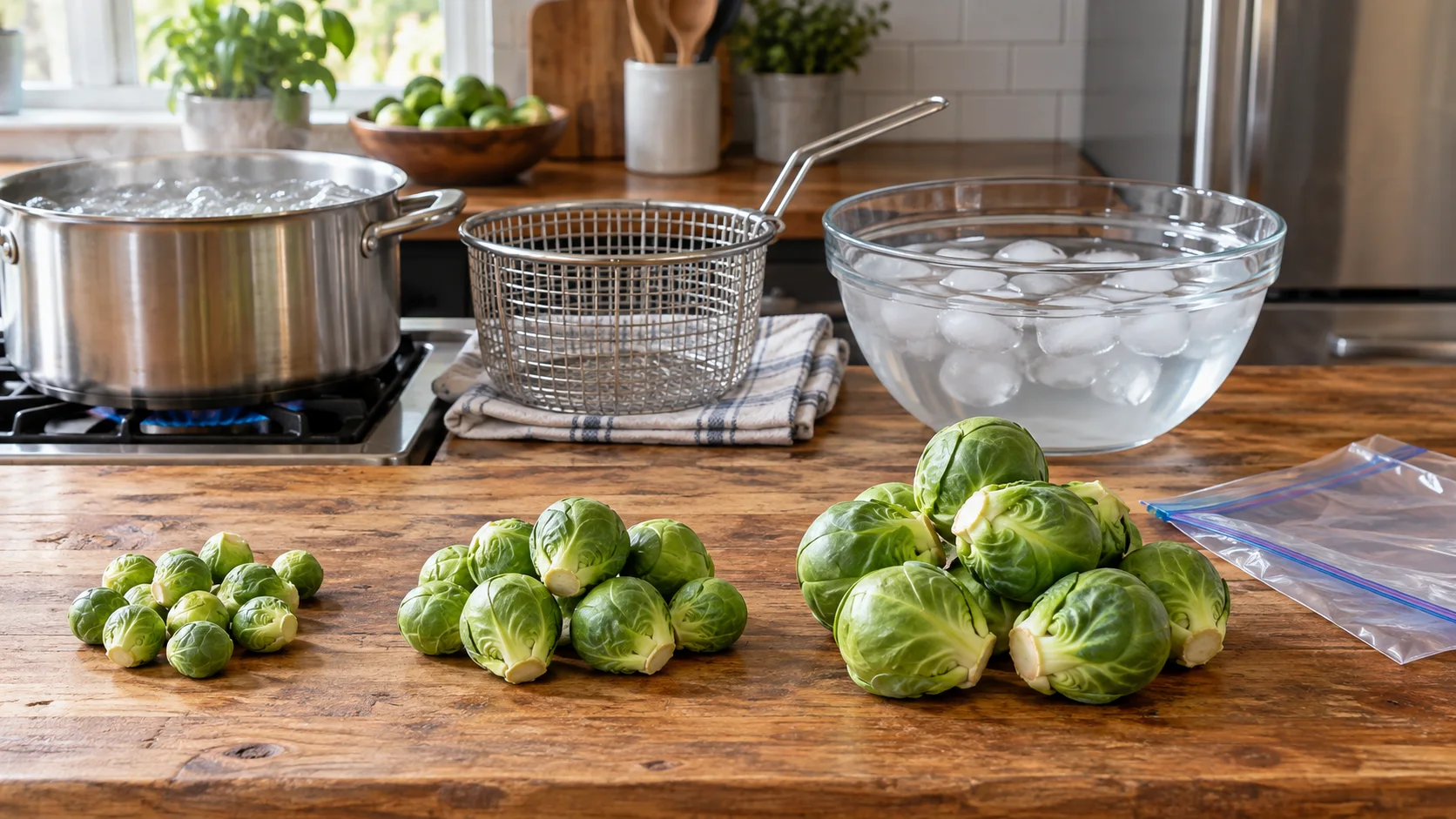
You can freeze raw Brussels sprouts, but skipping blanching is not the best method for quality. The National Center for Home Food Preservation recommends sorting clean, firm sprouts by size, then water-blanching small heads for 3 minutes, medium heads for 4 minutes, and large heads for 5 minutes. Cool them promptly in ice water for the corresponding time, drain thoroughly, package with no headspace, and freeze at 0°F or below.
Print a clean copy or save it as a PDF for the kitchen.
Saveable field method
How to freeze Brussels sprouts for better quality
Sort, water-blanch, cool, drain, package, and freeze Brussels sprouts using the National Center for Home Food Preservation method.
What you need
- Fresh green, firm, compact Brussels sprouts
- Cold running water
- Ice and cold water
- Moisture-vapor-resistant freezer bags or containers
- Labels and a permanent marker
- Paring knife and cutting board
- Large pot with lid
- Blanching basket or wire basket
- Large bowl for ice water
- Colander or clean towels
- Kitchen timer
- Choose and inspect
Select green, firm, compact sprouts. Examine each head carefully for insects and discard any sprout with decay or serious damage.
- Trim, wash, and sort
Trim the stem ends, remove coarse or damaged outer leaves, wash thoroughly under cold running water, and sort the sprouts into separate small, medium, and large groups.
- Prepare the blanching and cooling stations
Bring a large covered pot of water to a vigorous boil. Fill a separate large bowl with ice water before adding any sprouts to the pot.
- Blanch each size separately
Water-blanch small sprouts for 3 minutes, medium sprouts for 4 minutes, and large sprouts for 5 minutes. Start timing when the water returns to a boil.
- Cool promptly and drain
Transfer each batch immediately to ice water and cool it for about the same length of time as its blanch. Drain thoroughly and blot away excess surface water if needed.
- Pack, label, and freeze
Pack the cooled, well-drained sprouts in freezer bags or containers with no headspace, remove excess air, seal, label with the date, and freeze promptly at 0°F or below.
What happens if you freeze Brussels sprouts raw?
Raw Brussels sprouts will become solid in the freezer, but freezing does not immediately stop every enzyme that changes color, flavor, and texture. During storage, unblanched sprouts can lose quality faster and develop a softer, less appealing result.
Blanching is therefore mainly a quality step, not a way to rescue poor produce. Begin with green, firm, compact heads, inspect them carefully for insects, and remove any damaged outer leaves before washing.
Sort by size before the water boils
The tested method uses three different times, so do not mix every size in one batch. After trimming the stem ends and removing coarse outer leaves, divide the sprouts into small, medium, and large groups.
The NCHFP directions do not assign exact diameters to those groups. Make three visibly consistent piles and process them separately; that is more reliable than giving small heads the large-head time or underprocessing the largest heads.
Use the 3-4-5 blanching rule
Water-blanch small Brussels sprouts for 3 minutes, medium sprouts for 4 minutes, and large sprouts for 5 minutes. Lower one size group into vigorously boiling water, cover the pot, and start the timer when the water returns to a boil.
Work in manageable batches so the water resumes boiling quickly. If it does not return to a boil within about one minute, reduce the next batch. The published Brussels sprouts method specifies water blanching; it does not give a steam-blanching schedule.
Cool for the matching amount of time
Move each batch directly from the pot to a large bowl of ice water. General NCHFP blanching guidance says to cool vegetables for the same amount of time used for blanching, so cool small sprouts about 3 minutes, medium about 4, and large about 5.
Keep the cooling water cold by adding more ice between batches. Drain thoroughly afterward; clinging water forms loose ice in the package and can make the thawed sprouts wetter.
Pack with no headspace
The NCHFP Brussels sprouts method calls for no headspace. Pack cooled, drained sprouts tightly in freezer containers or press excess air from freezer bags without crushing the heads.
Label each package with the food and freeze date, then freeze promptly at 0°F or below. Meal-size portions freeze faster and are easier to use than one oversized package that must be repeatedly opened.
How to cook frozen Brussels sprouts
Freezing softens plant cells, so thawed Brussels sprouts will not have the exact bite of fresh ones. For less surface moisture, cook them directly from frozen rather than leaving them to thaw in a bowl.
They work well roasted on a preheated pan, sautéed after a brief steam, or added to soup, casserole, pasta, or a sheet-pan meal. Dry seasonings and a little oil adhere best after visible ice has melted away during cooking.
How long do frozen Brussels sprouts keep?
The NCHFP Brussels sprouts page does not publish a sprout-specific discard date. Its general guidance places properly prepared and packaged fruits and vegetables in an 8-to-12-month window for best quality when held continuously at 0°F or below.
That range is about quality rather than an automatic safety deadline. Air leaks, temperature changes, and excess surface water speed freezer burn and flavor loss, so rotate older packages forward and use them first.
Is freezing Brussels sprouts an Amish practice?
No. Freezing Brussels sprouts is a general modern preservation method, not a practice unique to Amish households. Amish communities vary in technology use, and a freezer habit should not be attributed to all Amish people.
Preserving a seasonal surplus is a broadly frugal household practice. The exact preparation and timing in this guide come from university-based home food-preservation guidance, not from an unsupported cultural claim.
Frequently asked questions
Can you freeze fresh Brussels sprouts without cooking them?
You can physically freeze them raw, but quality declines faster. The NCHFP method recommends water-blanching the sprouts according to size before cooling and freezing.
How long should Brussels sprouts be blanched before freezing?
Water-blanch small heads for 3 minutes, medium heads for 4 minutes, and large heads for 5 minutes. Process each size separately and start timing when the water returns to a boil.
Should you cut Brussels sprouts in half before freezing?
The tested NCHFP method keeps the heads whole, trims them, removes coarse outer leaves, and sorts them by size. Use its whole-head 3-, 4-, or 5-minute schedule rather than inventing a different time for halved sprouts.
How long should Brussels sprouts stay in ice water?
Cool them for about the same length of time as their blanch: roughly 3 minutes for small heads, 4 for medium, and 5 for large. Keep the water icy between batches.
How much headspace do frozen Brussels sprouts need?
The NCHFP method says to package cooled, drained sprouts with no headspace. Remove excess air from freezer bags before sealing.
Why are my frozen Brussels sprouts mushy?
Some softening is normal after freezing. Mixing sizes during blanching, overblanching small heads, slow cooling, excess package water, thawing before cooking, and temperature swings can make the texture softer still.
Sources and further reading
- National Center for Home Food Preservation — Freezing Brussels Sprouts
- National Center for Home Food Preservation — Blanching Vegetables
- National Center for Home Food Preservation — How Long Can I Store Frozen Foods?
- FoodSafety.gov — Cold Food Storage Charts
- Young Center for Anabaptist and Pietist Studies — Amish Diversity
This article may use AI-assisted research organization and drafting. Claims involving safety, energy, or household costs are checked against the named sources above. Read about the founder and our editorial standards.