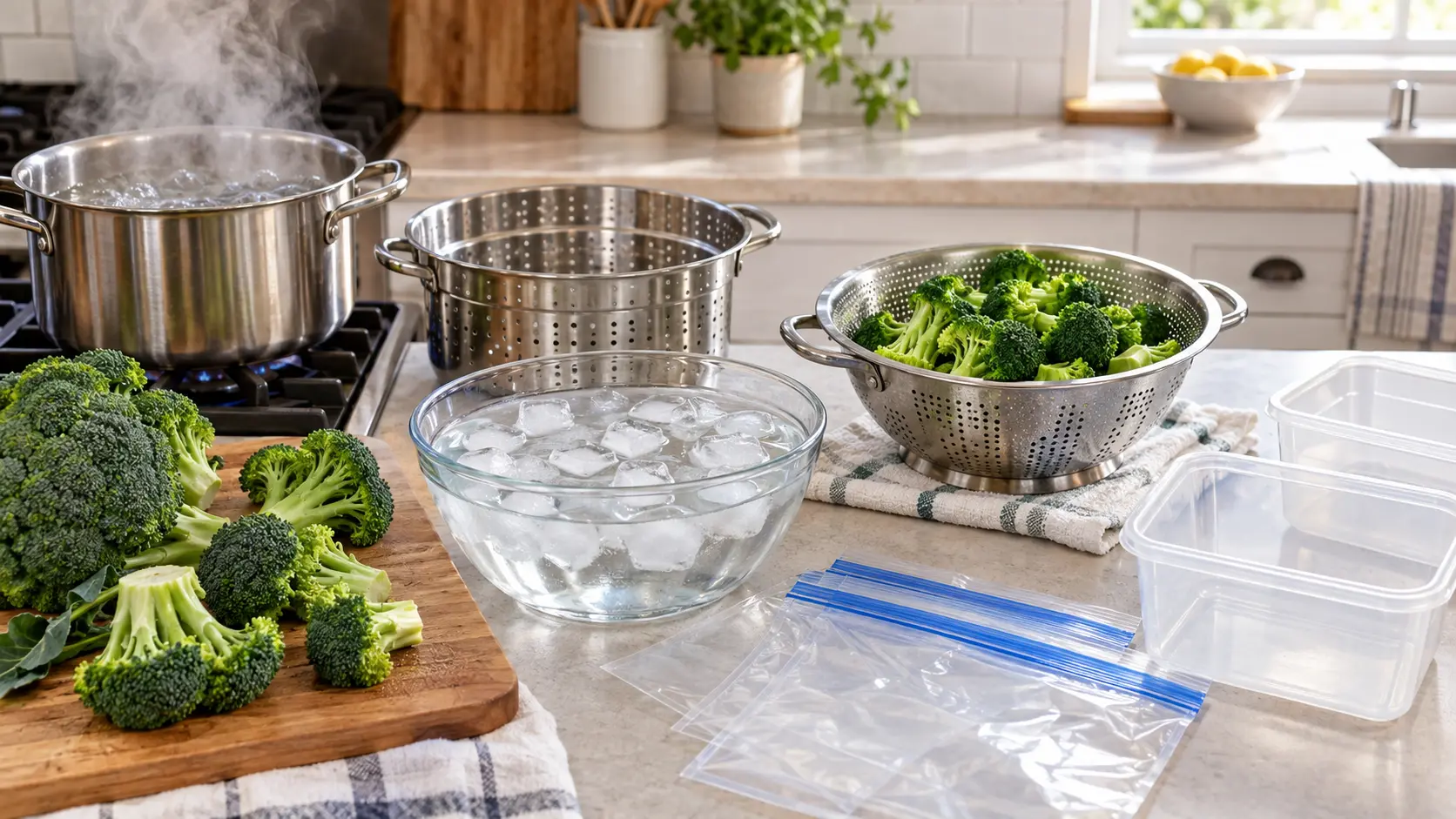
You can put raw broccoli in a freezer, but the tested method for dependable long-term quality is to blanch it first. Choose firm, tender stalks with compact heads; cut florets no more than 1½ inches across; water-blanch for 3 minutes or steam-blanch for 5 minutes; cool promptly for about the same time; drain thoroughly; then pack tightly with no headspace and freeze at 0°F or below. Blanching protects quality—it is not a canning step.
Print a clean copy or save it as a PDF for the kitchen.
Saveable field method
How to freeze broccoli for dependable quality
Prepare, water- or steam-blanch, cool, drain, pack, and freeze broccoli using the National Center for Home Food Preservation method.
What you need
- Firm, young broccoli with compact heads
- Water
- Ice
- Salt for the insect-removal soak
- Moisture-vapor-resistant freezer containers or freezer bags
- Labels and a permanent marker
- Knife and cutting board
- Large pot with lid and blanching basket
- Steamer basket, if steam-blanching
- Large bowl for ice water
- Colander and clean kitchen towels
- Select and trim
Choose firm, young, tender stalks with compact heads. Remove leaves and woody portions, then split lengthwise so the florets are no more than 1½ inches across.
- Wash and soak
Wash thoroughly. To remove insects, immerse the prepared broccoli for 30 minutes in a solution of 4 teaspoons salt per gallon of water, then rinse and drain.
- Choose water or steam
For water blanching, use about 1 gallon of vigorously boiling water per pound of broccoli. For steam blanching, keep the basket at least 3 inches above 1 to 2 inches of boiling water and arrange the florets in a single layer.
- Blanch for the exact time
Water-blanch for 3 minutes, starting when the water returns to a boil. Or cover and steam-blanch for 5 minutes, starting as soon as the lid is on. Keep the heat high.
- Cool and drain promptly
Move the broccoli immediately into ice water and cool it for about the same time as blanching—3 minutes after water blanching or 5 minutes after steaming. Drain thoroughly.
- Pack, label, and freeze
Pack the cooled florets tightly in freezer containers or bags with no headspace. Remove excess air where practical, seal, label with the date, and freeze promptly at 0°F or below.
Why blanch broccoli before freezing?
Freezing slows change, but it does not stop every enzyme in a vegetable. The National Center for Home Food Preservation says blanching slows or stops enzymes that can cause losses of flavor, color, and texture during frozen storage. It also helps clean the surface, brightens the color, and makes broccoli easier to pack.
Timing is important. Underblanching can stimulate enzyme activity and is worse than no blanching, while overblanching can reduce flavor, color, texture, vitamins, and minerals. Broccoli needs 3 minutes in boiling water or 5 minutes in steam.
Can you freeze raw broccoli?
Raw broccoli will physically freeze, but skipping blanching is not the tested NCHFP method for dependable long-term quality. If you are preserving a garden harvest or sale-priced broccoli for later meals, the short blanch is the better-supported choice.
Blanching is a freezer-quality step, not a process that makes broccoli shelf-stable. Keep frozen broccoli frozen. These instructions are not a home-canning method, and packaged broccoli does not belong in a pantry.
Water blanching versus steam blanching
Both methods are satisfactory for broccoli. Water blanching is faster: use about 1 gallon of water per pound, lower the basket into vigorously boiling water, cover, and start the 3-minute timer when the water returns to a boil. If it does not reboil within 1 minute, the batch is too large for the pot.
Steam blanching takes 5 minutes. Keep the food at least 3 inches above the water, arrange florets in a single layer so steam reaches every piece, cover tightly, and begin timing as soon as the lid is on. Microwave blanching is not a dependable substitute; NCHFP says it may not inactivate enzymes and does not save time or energy.
How to avoid watery, icy broccoli
Cool promptly for about the same amount of time as blanching, then drain thoroughly. NCHFP warns that extra moisture can reduce quality after freezing. A colander followed by clean towels can remove surface water without leaving the broccoli sitting warm.
Pack the cooled broccoli tightly in freezer-grade bags or rigid containers with no headspace, remove excess air where practical, and label the date. Unlike spinach and several other vegetables, the specific NCHFP broccoli directions call for no headspace.
How long frozen broccoli keeps and where it works best
NCHFP gives properly prepared fruits and vegetables an approximate 8-to-12-month quality window at 0°F. This assumes correct preparation, moisture-vapor-resistant packaging, and continuous frozen storage. Rotate the oldest packages forward.
Frozen broccoli will not be identical to fresh raw florets. Use it where a tender texture is welcome: soups, casseroles, pasta, stir-fries, roasted dishes, and cooked side dishes. Cooking directly from frozen often limits extra handling and keeps meal preparation simple.
Is freezing broccoli an Amish practice?
No. Freezing and blanching broccoli is general modern food-preservation guidance, not a practice unique to Amish households. Amish communities are diverse, and technology choices vary by affiliation and local church district.
The frugal principle—preserving seasonal abundance instead of wasting it—fits many households. The technical method here comes from current university-based preservation guidance, not from an unsupported cultural claim.
Frequently asked questions
How long should you blanch broccoli before freezing?
Water-blanch broccoli florets for 3 minutes or steam-blanch them for 5 minutes. Cool promptly for about the corresponding time, then drain thoroughly.
Do you need to soak broccoli before freezing it?
NCHFP directs home preservers to immerse prepared broccoli for 30 minutes in a solution of 4 teaspoons salt per gallon of water to remove insects. Rinse and drain before blanching.
How large should broccoli florets be for freezing?
Remove leaves and woody portions, separate the head into useful sections, and split lengthwise so florets are no more than 1½ inches across. Similar sizes heat and cool more evenly.
Can you microwave-blanch broccoli?
NCHFP says microwave blanching may not inactivate enzymes effectively and does not save time or energy. Use the prescribed boiling-water or steam method instead.
Does frozen broccoli need headspace?
The specific NCHFP broccoli directions say to pack it tightly with no headspace. Drain thoroughly first and use freezer-grade packaging.
How long is frozen broccoli good for?
NCHFP lists an approximate 8-to-12-month best-quality window for properly prepared fruits and vegetables stored at 0°F or below. Date packages and use the oldest first.
Sources and further reading
- National Center for Home Food Preservation — Freezing Broccoli
- National Center for Home Food Preservation — Blanching Vegetables
- National Center for Home Food Preservation — How Long Can I Store Frozen Foods?
- Young Center for Anabaptist and Pietist Studies — Amish Diversity
This article may use AI-assisted research organization and drafting. Claims involving safety, energy, or household costs are checked against the named sources above. Read about the founder and our editorial standards.