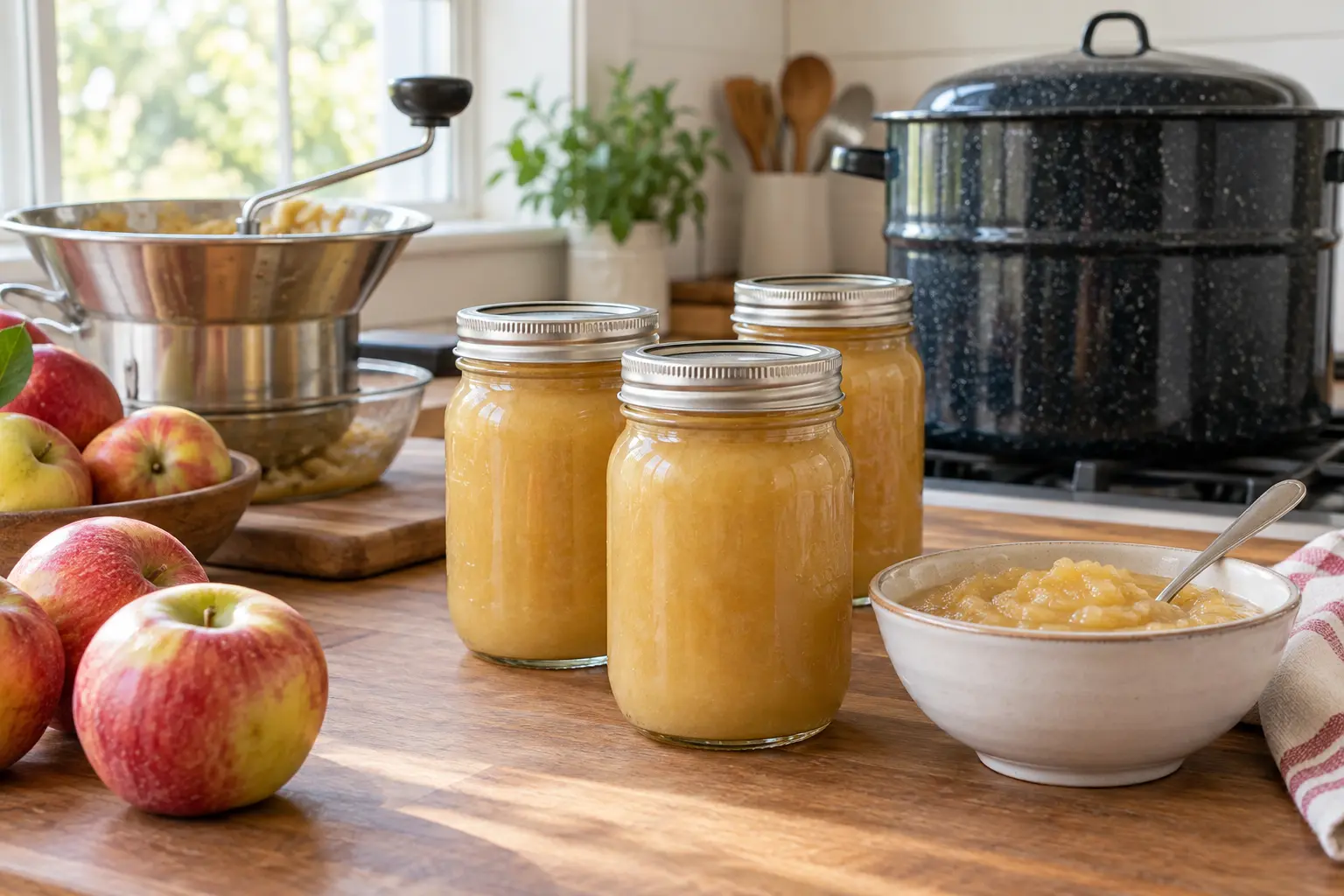
Yes. The National Center for Home Food Preservation specifically says applesauce may be canned without sugar. Sugar is optional for flavor—not the safety control in this tested method. Wash, peel, core, and cook the apples; make the sauce smooth or chunky; reheat it to boiling; fill hot pint or quart jars with ½ inch of headspace; and process in a boiling-water canner for the full time required at your elevation. Do not skip the hot pack or the canning process just because the sauce contains no added sugar.
Print a clean copy or save it as a PDF for the kitchen.
Saveable field method
How to safely water-bath can unsweetened applesauce
Follow the current USDA-based hot-pack method, using no added sugar and the correct processing time for your jar size and elevation.
What you need
- Sweet, juicy, crisp apples, with some tart apples if desired
- ½ cup water for an 8- to 10-quart pot of prepared apple slices
- Clean pint or quart canning jars with new lids
- Ascorbic-acid holding solution, optional for color
- Boiling-water canner with rack and lid
- 8- to 10-quart cooking pot
- Food mill or sieve for smooth sauce, optional
- Jar lifter, canning funnel, and headspace tool
- Choose and prepare sound apples
Use sweet, juicy, crisp fruit. Wash, peel, core, and slice the apples. Remove bruised or decayed areas; hold slices in an ascorbic-acid solution if you want to limit browning.
- Cook until tender
Put the drained slices in an 8- to 10-quart pot with ½ cup water. Heat quickly for 5 to 20 minutes, depending on variety and maturity, stirring often enough to prevent scorching.
- Make the texture you want
Press the tender apples through a food mill or sieve for smooth sauce, or omit that step for chunky sauce. Leave the sugar out; the tested NCHFP method explicitly permits unsweetened sauce.
- Return the sauce to a boil
Reheat the finished sauce to a full boil while stirring to prevent sticking. This is a hot-pack process; do not put cold sauce into jars for shelf-stable canning.
- Fill the hot jars
Ladle boiling applesauce into hot pint or quart jars, leaving ½ inch of headspace. Remove trapped air, readjust the headspace if needed, wipe the rims, and apply lids as directed by the manufacturer.
- Process for jar size and elevation
Water-bath process pints for 15, 20, 20, or 25 minutes and quarts for 20, 25, 30, or 35 minutes across the elevation bands 0–1,000, 1,001–3,000, 3,001–6,000, and above 6,000 feet. Start timing when the water returns to a full boil.
Why applesauce is safe to can without sugar
In the tested applesauce method, safety comes from using suitable apples, preparing and hot-packing the sauce as directed, leaving the specified headspace, and completing an altitude-adjusted heat process. The NCHFP says plainly that sauce may be packed without sugar, then lists sugar only as an optional addition for taste.
That rule does not transfer to every preserve. Sugar can be essential to the structure or preservation of some jams, jellies, heavy-syrup preserves, and pickled products. Treat “sugar optional” as a recipe-specific instruction, not a blanket canning substitution rule.
Water-bath times for unsweetened applesauce
For hot-packed pints, process 15 minutes at 0–1,000 feet, 20 minutes at 1,001–3,000 feet, 20 minutes at 3,001–6,000 feet, or 25 minutes above 6,000 feet. For quarts, use 20, 25, 30, or 35 minutes across those same elevation bands.
The lack of added sugar does not change these times. Keep the canner at a vigorous boil throughout the process, and use the complete NCHFP directions. If boiling stops, bring the water back to a full boil and restart the processing time from the beginning.
Do you need lemon juice in canned applesauce?
The NCHFP applesauce recipe does not call for bottled lemon juice. Do not add it as a substitute for the required heat process. If you like a brighter flavor, you may sweeten or season the sauce when serving, but the safest simple choice is to follow the tested applesauce formula exactly as published.
Tomatoes are different: their tested canning directions require measured acid in every jar. Recipe-specific controls matter, which is why a rule from one food should never be carried into another without a tested source.
Smooth, chunky, and naturally sweet options
For smooth sauce, use a food mill or sieve after the apples soften. For chunky sauce, the NCHFP permits skipping that pressing step. Choose naturally sweet apples and blend in some tart fruit for a fuller flavor; the Center suggests 1 to 2 pounds of tart apples for each 3 pounds of sweeter apples.
Taste the hot sauce before filling jars, but do not add untested thickeners. Cinnamon or other extras should come from a tested recipe or be added after opening. Plain unsweetened jars are flexible for breakfast, baking, pork dishes, and later sweetening at the table.
Common mistakes that can spoil a batch
Do not raw-pack cold sauce, reduce the processing time, use a jar larger than a quart, or guess your elevation. Keep ½ inch of headspace and stir while reheating so thick sauce does not scorch. Oregon State University Extension also advises peeling the apples, especially windfalls, because unpeeled applesauce has shown a higher incidence of spoilage during storage.
After processing, cool the jars undisturbed for 12 to 24 hours, check the seals, label them, and store them in a cool, dark, dry place. Refrigerate and promptly use any jar that failed to seal; discard any jar that leaks, spurts, smells abnormal, or shows mold or other spoilage signs without tasting it.
Is unsweetened applesauce an Amish practice?
No. Making and preserving applesauce is a broadly used seasonal kitchen practice, not an exclusively Amish tradition. Amish communities are diverse, and household practices vary by affiliation, church district, family, and access to technology.
An Amish-inspired pantry may value seasonal food and waste reduction, but every safety instruction and processing time in this guide comes from the National Center for Home Food Preservation and university Extension guidance—not from a cultural claim.
Frequently asked questions
Is sugar necessary to preserve canned applesauce?
No. In the tested NCHFP applesauce method, sugar is optional. Safety depends on the specified preparation, hot pack, ½-inch headspace, jar size, and altitude-adjusted processing time.
How long do you water-bath unsweetened applesauce?
At 0–1,000 feet, process hot-packed pints for 15 minutes or quarts for 20 minutes. Higher elevations require longer times: up to 25 minutes for pints and 35 minutes for quarts above 6,000 feet.
Can I add a sugar substitute before canning applesauce?
You do not need one for safety. The simplest tested option is to can the sauce plain and sweeten individual servings after opening. If using a non-sugar sweetener, check the product's suitability for heating and canning and keep every other part of the tested method unchanged.
Does canned applesauce need bottled lemon juice?
The current NCHFP applesauce recipe does not require bottled lemon juice. Follow that complete recipe instead of borrowing acidification rules from tomatoes or other products.
Can I leave the apple peels in applesauce for canning?
Use the tested directions and peel the apples. Oregon State University Extension notes that peeling is especially important for windfalls and that unpeeled applesauce can have more spoilage during storage.
Can I can chunky applesauce without sugar?
Yes. The NCHFP method permits skipping the food mill or sieve for chunky sauce and permits packing the sauce without sugar. Reheat it to boiling and follow the same headspace and processing table.
Sources and further reading
- National Center for Home Food Preservation — Applesauce
- USDA Complete Guide to Home Canning — Fruit and Fruit Products
- Oregon State University Extension — Preserving Foods: Apples (revised November 2024)
- Young Center for Anabaptist and Pietist Studies — Amish Diversity
This article may use AI-assisted research organization and drafting. Claims involving safety, energy, or household costs are checked against the named sources above. Read about the founder and our editorial standards.