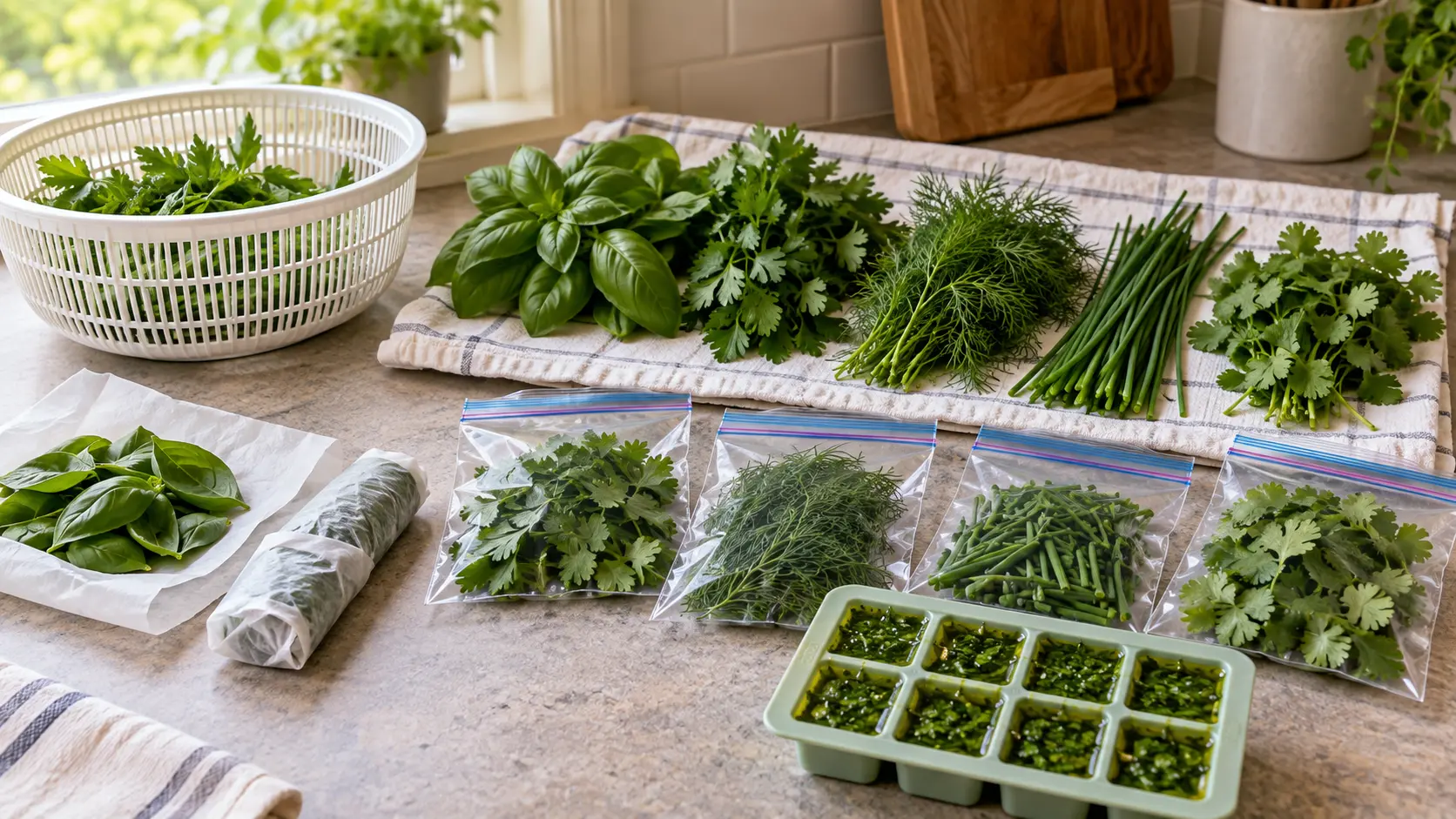
Yes. Fresh herbs can be frozen without blanching. Wash them, drain well, pat them thoroughly dry, wrap a few sprigs or leaves in freezer wrap, place the packets in a freezer bag, seal, label, and freeze at 0°F or below. The leaves become limp after thawing, so chop or crumble them directly into cooked dishes rather than using them as a fresh garnish.
Print a clean copy or save it as a PDF for the kitchen.
Saveable field method
How to freeze fresh herbs without blanching
Wash, dry, portion, wrap, label, and freeze fresh herb sprigs or leaves using the National Center for Home Food Preservation method.
What you need
- Fresh, sound herb sprigs or leaves
- Cold running water
- Paper towels or clean kitchen towels
- Freezer wrap
- Moisture-vapor-resistant freezer bags
- Labels and a permanent marker
- Salad spinner or colander
- Clean work surface
- Knife and cutting board for later chopping, if needed
- Choose sound herbs
Use fresh sprigs or leaves at good quality. Discard yellowed, slimy, moldy, or decaying portions before washing.
- Wash gently
Rinse the herbs thoroughly in cold water, moving leaves apart so water reaches hidden soil and debris.
- Drain and dry completely
Drain well, then pat the herbs dry with paper towels or clean kitchen towels. A salad spinner can remove most water before the final towel dry.
- Make useful portions
Group a few sprigs or leaves into the amount you normally add to one meal. Keep varieties separate unless you deliberately want a labeled cooking blend.
- Double-wrap for the freezer
Wrap each small portion in freezer wrap, place the packets in a freezer bag, press out excess air without crushing the herbs, and seal.
- Label, freeze, and cook from frozen
Label the herb, date, and approximate portion. Freeze promptly at 0°F or below, then chop or crumble the frozen leaves directly into cooked dishes as needed.
Fresh herbs do not need blanching before freezing
The National Center for Home Food Preservation gives a simple raw-freezing method for fresh herbs: wash, drain, pat dry, wrap a few sprigs or leaves in freezer wrap, place them in a freezer bag, seal, and freeze. No boiling-water or steam blanch is included.
That makes herbs different from many vegetables in the site's freezing guide. The important preparation step is removing surface moisture so the leaves do not enter the package dripping wet and form unnecessary ice.
The best method for whole sprigs and leaves
Freeze small meal-size bundles rather than one large block. A few wrapped sprigs inside a larger freezer bag are easy to separate, reduce repeated air exposure, and make it less likely that more herbs are thawed than a recipe needs.
Label the variety clearly—especially similar-looking herbs—and include the date. Parsley, dill, cilantro, chives, basil, thyme, oregano, sage, and rosemary can all be portioned this way, although their aroma and post-thaw texture will vary.
Can you freeze chopped herbs in olive oil?
Yes, when the mixture goes directly into the freezer. Penn State Extension recommends mixing ⅓ to ½ cup of oil with 2 cups of chopped herbs. Portion the mixture in a freezer-safe tray or small container, label it, and keep it frozen. Because oil does not freeze as hard as water, a small amount can be scraped out for cooking.
Use oil portions for soups, sauces, sautés, roasted vegetables, and other cooked dishes. Do not present them as shelf-stable infused oil, and do not leave fresh herb-and-oil mixtures at room temperature.
What texture should you expect after thawing?
Frozen herbs usually become limp after thawing, so they are not a good substitute for crisp fresh garnish. This is normal quality change, not proof that the freezing method failed.
Add frozen leaves directly to a simmering soup, stew, sauce, casserole, egg dish, or skillet. Keeping them frozen until the moment of use preserves more aroma and avoids a wet pile on the cutting board.
How long frozen herbs keep
The NCHFP fresh-herb page does not publish a herb-specific storage time. Its general chart gives correctly prepared and packaged fruits and vegetables an approximate 8-to-12-month best-quality range at 0°F or below, while emphasizing that storage times are estimates and quality depends on preparation, packaging, and temperature.
For delicate herb aroma, earlier use is usually more satisfying. Date every package, keep the freezer at 0°F or below, and rotate the oldest portions forward instead of waiting for the maximum general range.
Fresh herbs in oil need a food-safety boundary
Oil limits oxygen around moist plant material. Penn State Extension advises making fresh herb-infused oils for immediate refrigerated use—generally within 2 to 4 days—or freezing them. A room-temperature bottle is not made safe merely because it looks or smells normal.
Garlic-in-oil deserves particular care: NCHFP says to refrigerate it at 40°F or below for no more than 4 days or freeze it for longer storage. This freezer guide is not a canning or pantry-storage method.
Is freezing herbs an Amish practice?
No. Freezing fresh herbs is a general modern preservation technique, not a practice unique to Amish households. Amish communities are diverse, and technology choices vary by affiliation and local church district.
Using a seasonal surplus instead of wasting it is a broadly frugal household habit. The technical directions here come from university-based food-preservation guidance, not from an unsupported cultural claim.
Frequently asked questions
Do you have to blanch basil, parsley, or cilantro before freezing?
No. NCHFP's fresh-herb method does not call for blanching. Wash, drain, pat thoroughly dry, wrap small portions, place them in a freezer bag, seal, and freeze.
Should herbs be dry before freezing?
Yes. Drain them well and pat them dry before wrapping. Removing surface water limits unnecessary ice and makes the portions easier to use later.
Can frozen herbs be used as garnish?
Usually not. Frozen leaves become limp after thawing. Chop or crumble them into cooked dishes where flavor matters more than a crisp appearance.
Can you freeze herbs in olive oil?
Yes. Penn State Extension recommends ⅓ to ½ cup of oil for 2 cups of chopped herbs. Portion and freeze the mixture promptly; do not store fresh herb-and-oil mixtures at room temperature.
How long can fresh herb oil stay in the refrigerator?
Penn State advises using fresh herb-infused oils within 2 to 4 days when refrigerated. NCHFP specifically limits refrigerated garlic-in-oil to 4 days at 40°F or below. Freeze portions for longer storage.
How long do frozen herbs last?
NCHFP does not give fresh herbs a separate time. Its general best-quality estimate for correctly prepared fruits and vegetables is 8 to 12 months at 0°F or below, but delicate herb flavor is often better when used sooner.
Sources and further reading
- National Center for Home Food Preservation — Freezing Fresh Herbs
- Penn State Extension — Freezing Herbs (July 22, 2025)
- Penn State Extension — How to Safely Make Infused Oils (April 4, 2024)
- National Center for Home Food Preservation — Freezing Garlic-In-Oil
- National Center for Home Food Preservation — How Long Can I Store Frozen Foods?
- Young Center for Anabaptist and Pietist Studies — Amish Diversity
This article may use AI-assisted research organization and drafting. Claims involving safety, energy, or household costs are checked against the named sources above. Read about the founder and our editorial standards.