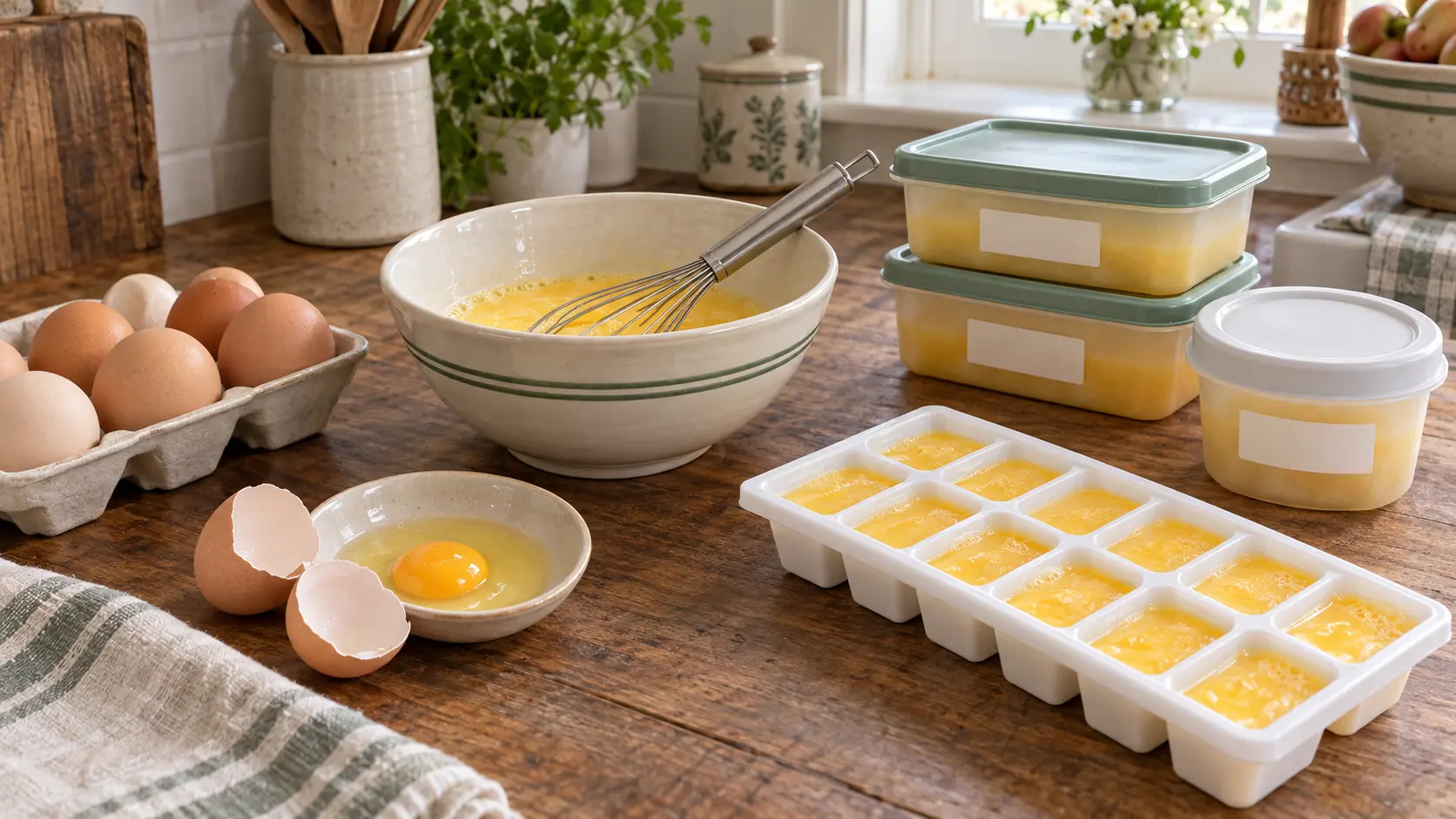
No. Do not intentionally freeze raw eggs in their shells: the contents expand and the shell may crack. Instead, crack each fresh egg into a clean saucer, check it, remove any shell, then combine it with the rest. For whole eggs, gently mix yolks and whites without whipping in air; add 1½ tablespoons sugar, 1½ tablespoons corn syrup, or ½ teaspoon salt per cup to limit graininess, choosing the additive for the final use. Freeze in labeled portions with ½ inch of headspace. Three tablespoons of mixed egg equal one large egg.
Print a clean copy or save it as a PDF for the kitchen.
Saveable field method
How to freeze raw eggs without the shells
Crack, inspect, gently mix, measure, label, and freeze eggs in recipe-ready portions using the NCHFP method.
What you need
- Fresh, clean eggs
- Sugar or corn syrup for sweet uses, or salt for savory uses
- Moisture-vapor-resistant freezer containers or freezer bags
- Labels and a permanent marker
- Clean saucer
- Mixing bowl and fork or whisk
- Measuring spoons and measuring cup
- Sieve or colander, optional for a more uniform mixture
- Ice cube tray, optional for individual portions
- Crack and inspect one egg at a time
Break each egg into a clean saucer before adding it to the mixing bowl. Check freshness and remove shell pieces so one poor egg does not spoil the entire batch.
- Choose whole eggs, whites, or yolks
Freeze each type separately. Whole eggs need yolks and whites gently combined; whites need only gentle mixing; yolks need a stabilizing ingredient to avoid a thick, grainy texture.
- Mix gently
Combine without whipping in extra air. For a smoother, more uniform result, strain the mixture through a clean sieve or colander after mixing.
- Treat whole eggs or yolks
Per cup of whole egg or yolk, gently mix in 1½ tablespoons sugar, 1½ tablespoons corn syrup, or ½ teaspoon salt. Use sugar or syrup for baking and desserts; use salt only when the eggs are destined for savory food. Egg whites need no additive.
- Measure and package
Portion mixed whole egg in 3-tablespoon amounts, whites in 2-tablespoon amounts, or yolks in 1-tablespoon amounts. Leave ½ inch of headspace in rigid containers. An ice tray can hold 3 tablespoons per compartment for one-egg portions.
- Label, freeze, and thaw safely
Label the type, quantity, additive, intended use, and date. Freeze promptly at 0°F or below. Thaw in the refrigerator, keep cold, and use the thawed egg in a thoroughly cooked dish.
Why eggs should not be frozen in their shells
Water inside a raw egg expands as it freezes. That can crack the shell and remove the egg's physical barrier against contamination. FoodSafety.gov therefore says not to freeze raw eggs in the shell and to discard an accidentally frozen egg if its shell has broken.
If an accidentally frozen shell egg remains intact, keep it frozen until you are ready to thaw it in the refrigerator, then use it immediately. That narrow exception is not a reason to put cartons of shell eggs in the freezer on purpose.
Whole eggs, yolks, and whites need different treatment
For whole eggs, gently combine the yolks and whites. The National Center for Home Food Preservation recommends adding sugar, corn syrup, or salt per cup to help prevent graininess. Choose one based on the recipes you expect to make and write it on the label; a salted portion can ruin a cake, while a sweetened portion may not belong in an omelet.
Yolks also need the measured sugar, corn syrup, or salt treatment. Whites do not: gently mix and strain them, then package. Do not beat any mixture into a foam before freezing because trapped air makes portioning less reliable.
The freezer equivalents worth writing on the label
Measure before freezing so you do not have to guess after thawing. NCHFP equivalents are 3 tablespoons of mixed whole egg for one whole egg, 2 tablespoons of egg-white mixture for one white, and 1 tablespoon of yolk mixture for one yolk.
Labels should record the number of egg equivalents, whether salt, sugar, or syrup was added, and the intended use. Small recipe-size portions reduce waste because you can thaw only what the next dish needs.
How long frozen eggs keep
FoodSafety.gov lists 12 months for raw egg whites and yolks stored at 0°F or below. The freezer times in its chart are quality guidance: food held continuously at 0°F remains frozen, but flavor and performance can decline over time.
Use moisture-vapor-resistant packaging, remove excess air where practical, and keep the freezer at 0°F or colder. Date every package and rotate the oldest portions forward rather than creating a forgotten freezer inventory.
What does not freeze well
Hard-cooked eggs do not freeze well; FoodSafety.gov lists them as 'do not freeze.' Their whites become tough and watery. Egg salads and homemade eggnog also do not freeze well according to the same federal storage chart.
Baked egg casseroles are different: the federal chart gives a 2-to-3-month freezer quality window after baking. Cool a cooked dish promptly, divide it into practical portions, and follow the recipe's reheating guidance.
Is freezing eggs an Amish practice?
No. Freezing raw eggs out of the shell is a general modern preservation method, not a practice unique to Amish households. Amish communities are diverse, and use of electricity and household technology varies by affiliation and local church district.
The frugal idea is simply to avoid wasting a surplus while keeping portions useful. The technical method in this guide comes from current federal and university-based food-preservation guidance, not from an unsupported cultural claim.
Frequently asked questions
Can you freeze raw eggs in an ice cube tray?
Yes, after removing the shells and gently mixing the eggs. Measure 3 tablespoons of whole-egg mixture into each compartment, freeze until solid, then transfer the cubes promptly to a moisture-vapor-resistant freezer container. One 3-tablespoon cube equals one whole egg.
Do frozen whole eggs need salt or sugar?
NCHFP recommends ½ teaspoon salt, 1½ tablespoons sugar, or 1½ tablespoons corn syrup per cup of whole egg to limit graininess. Choose salt for savory recipes or sugar/syrup for sweet recipes and label the package clearly.
Can you freeze egg whites by themselves?
Yes. Gently mix and strain the whites without whipping, package with ½ inch of headspace, and freeze. No salt or sugar is needed. Two tablespoons of thawed white mixture equal one egg white.
Can you freeze egg yolks by themselves?
Yes, but gently mix in the measured salt, sugar, or corn syrup before freezing to prevent graininess. One tablespoon of the treated yolk mixture equals one yolk.
How long can raw eggs stay frozen?
FoodSafety.gov gives raw egg whites and yolks a 12-month freezer quality window at 0°F or below. Date each package and use the oldest first.
What should you do if an egg freezes accidentally in its shell?
Discard it if the shell cracked. If the shell remains intact, keep the egg frozen, thaw it in the refrigerator, and use it immediately in a thoroughly cooked dish. Do not intentionally freeze eggs in their shells.
Sources and further reading
- National Center for Home Food Preservation — Freezing Eggs
- FoodSafety.gov — Cold Food Storage Chart
- National Center for Home Food Preservation — How Long Can I Store Frozen Foods?
- Young Center for Anabaptist and Pietist Studies — Amish Diversity
This article may use AI-assisted research organization and drafting. Claims involving safety, energy, or household costs are checked against the named sources above. Read about the founder and our editorial standards.